



Photo by Síle Moloney
Editor’s Note: For full disclosure, during this election cycle, Norwood News has broadly covered campaign events which were brought to our attention by candidates who campaigned in our local reporting area of Bronx Community District 7, which broadly covers the neighborhoods of Norwood, Bedford Park, Fordham, Jerome Park, Kingsbridge Heights, Mosholu Parkway, and University Heights. Additionally, we did also cover Rev. Michael Blake‘s campaign launch in the South Bronx last year as we had a bit more time then, and former Gov. Andrew Cuomo’s launch, given he is so high-profile and because we had previously reported on his testing of the Bronx waters in 2022.
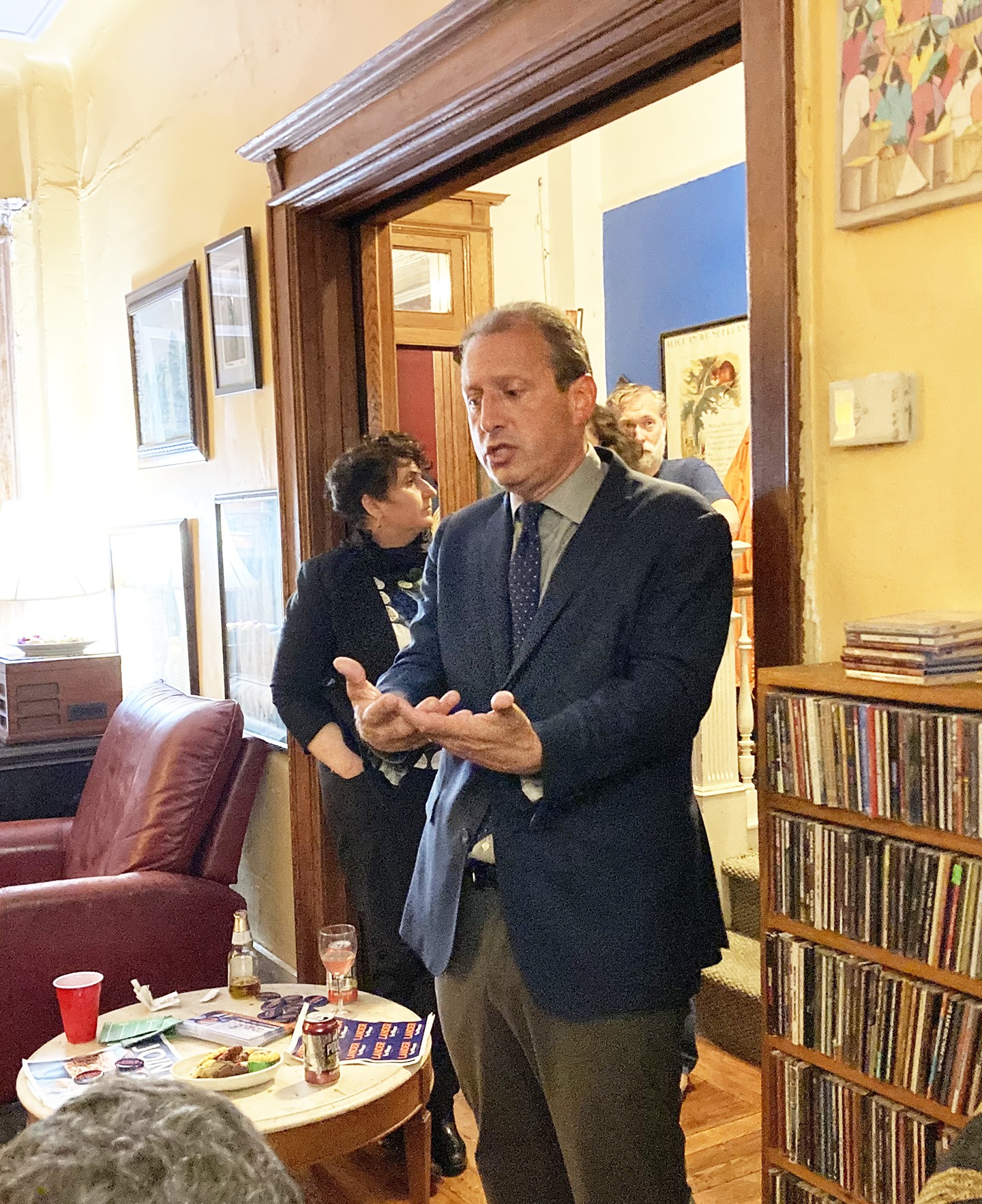
Democratic mayoral candidate and City Comptroller Brad Lander attended a Meet & Greet event in Norwood on Monday, June 16, as early voting was in full swing. The event was attended by about 30 to 40 people and was organized by former City Limits Editor Jarrett Murphy who, amid the COVID-19 pandemic, opted for a career change and is now a pediatric ER nurse.
Reflecting on the old adage, “There’s no Republican or Democratic way to take out the garbage,” Murphy said that on the contrary, garbage removal, like many other things, could be approached by different groups from several different perspectives, from worker conditions to recycling, to consumerism etc.
He said this was what made New York City politics so fascinating. “It’s what makes being the mayor of New York the toughest job in America,” he said, adding that noble concepts like democracy have to then get translated into the “unglamorous details” of policies that affect people’s everyday lives.
“I covered, in my previous career, six mayoral elections,” Murphy said in part. “I would say that of all the people I covered, almost no one had the ability to operate in all those spheres as ably as Brad.” He cited Lander’s time working as a nonprofit leader, operating in the housing realm, as a city council member weighing in on public safety, crafting the Gowanus rezoning in Brooklyn, and more recently his work as city comptroller to demonstrate his experience.
“Every mayor faces crises, every mayor is important,” Murphy said. “We don’t know what’s coming down the pipe. We couldn’t predict 9/11 or Superstorm Sandy or COVID-19 but even if nothing like that happens, what the next mayor is going to face is coming from Washington, threats to our democracy, the fiscal storm coming our way or, frankly, already arriving, threats to our citizens and our families, and our non-citizens and their families.”
Murphy said the next mayor would likely redefine what it means to be mayor and what it means to be a New Yorker. “I’m going to put my bet on Brad and hope everyone here will have an open mind as he speaks and talks to you and maybe go the same way.”
First up to grill Lander was 9-year-old Jackson who had zero hesitation in asking the candidate running for the highest office in the City about immigration policy, the recent raids by the U.S. Department of Immigration and Customs Enforcement (ICE), and their effects on local families and students. “[With] what Trump is doing to the whole of America and what these Republicans in general are doing, like separating families from each other, I think it is very important for people to have lawyers,” the 9-year-old posited.
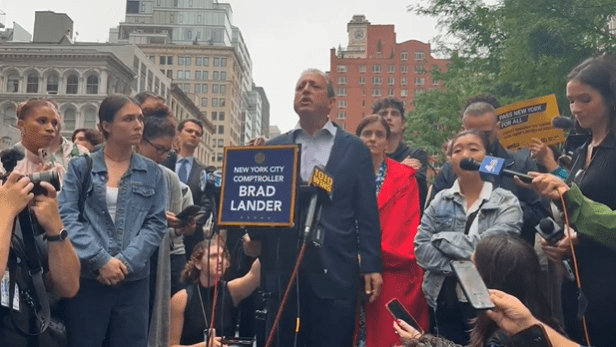
“Amen,” Lander replied earnestly. “I made this my number one priority for this year’s budget, that we should triple the amount of money that we’re spending so people have lawyers in housing court and [inaudible] immigration court.” As reported, the comptroller was arrested by federal agents on Tuesday, June 17, inside a Manhattan federal courthouse while asking to see the arrest warrant for an immigrant who was also being detained by ICE who he was accompanying. He was released later the same day after NY Gov. Kathy Hochul joined him in Manhattan and confirmed, to her knowledge, the charges had been dropped.
Lander said so many people impacted by the recent actions of ICE were “families in our schools.” He added, “We should make sure that the parent coordinator or the school counselor or […] the teachers know to let families know that we can get them a lawyer.” He said 40% of New Yorkers are immigrants, half of New York City residents live in mixed status households, meaning there is at least one immigrant in the house, and added that of New York’s 8[.2] million residents, one million are kids who either are, themselves, immigrants or who live in mixed status households.
“That is the future of New York City, so this is not just like a couple of families facing trouble,” Lander said. He explained that adult immigrants attending court are there while their kids are in school and are often afraid of being taken into custody on the spot and separated from their kids. “It goes totally against the values that New York is founded on,” Lander said.
Jackson wasn’t done and put it to Lander that there were a lot of experienced people running in the race like City Council Speaker Adrienne Adams and former New York Gov. Andrew Cuomo. He challenged Lander on why he had chosen to cross endorse “inexperienced, 33-year-old” Assemblyman Zohran Mamdani (A.D. 36) in the race.
Lander said he, himself, hoped to win but had cross endorsed Mamdani because a fundamental requirement to be mayor was to be someone of integrity, decency and honesty. “Andrew Cuomo has none of those [traits] and I really don’t want him to be the next mayor,” he said, adding, “I don’t have any doubt that Zohran would be a better mayor than Andrew Cuomo.”
He went on to say that Mamdani is running a really “inspiring campaign” around a vision of a City people can afford, and had gotten a lot of young people and others engaged in organizing in a way Lander had organized in his early days at a nonprofit to create housing opportunity and more. “I think that is very inspiring and I’m glad he’s doing it,” he said.
“The age is not the point,” Jackson countered, seemingly unconvinced. “It’s about how New York City fights this crisis,” referring to homeless people sleeping on the streets who have “absolutely nothing.” Jackson went on to say he believed Mamdani wants less cops on the streets and that if that were to happen, people wouldn’t feel safe using the subway. He also questioned Mamdani’s proposed tax increases. [We asked a Mamdani surrogate about the policing point and will address this in an upcoming story.]
Landon, who is Jewish, said that to be fair, Mamdani, who is Muslim, only wants to raise taxes on rich people, but acknowledged there were some questions about whether Mamdani’s proposed tax increases were realistic, and whether the State legislature would support them.

Screenshot courtesy of Dean Moses
In contrast, the comptroller said he believed the partnerships he has created with various groups to date, coupled with his experience, would help him see his own plan come to fruition, helping homeless people off the subway and connecting mentally ill people with housing and services.
Lander said he also believes he can find the money to do it and get all the different government agencies working together to make it happen. “Those are my skills,” he said. “I also think that the assembly member brings a vision for the City that is compelling and that is worth ranking second.”
One attendee called Omar said he was in complete despair after Trump won the presidency but in February when a Broadway Democratic club endorsed Lander, he said he would give him a shot because he remembered that Lander was a strong supporter of both Maya Wiley and Kathryn Garcia when they ran for mayor in 2021, and so was he.
A young high school student called Dan Schuchfeld wanted to know if Mayor Eric Adams’ “Vegan Fridays” in schools could be eliminated as he said the food was not good. Amid some laughter, Lander said there were some good plant-based foods out there but were maybe not the ones being served at his schools. Asked what constituted good food at his school, Dan said “chicken tenders” and “mozzarella sticks.”
Lander replied, “I hope we can find a way to have some healthy options that taste better than what they’re feeding you now, without it all being mozzarella sticks and chicken tenders, because we really do have an obesity crisis in the city, and people learn what they like at pretty young ages.”
He talked about gardens in schools for students to learn about where food comes from and for people to think about how they can make food that tastes good but is also healthy, in addition to learning math and reading. While he doesn’t believe everyone should be vegan, Lander said the mayor was trying to bring some attention to our food systems. He also supported the mayor’s focus on early reading in the early grades and putting lids on trash cans.
Lorita Watson said she was not a big fan of mayoral control of schools and favored community involvement in schools. Lander said the two tended to get mixed up. “I think it’s better if the mayor appoints the schools chancellor and I think it’s better if the chancellor finds good superintendents, and the superintendents find good principals,” he said.
The comptroller said that was different from how parents, students and educators engage in setting vision and policy at the school level through the school leadership teams at the district level, through the Community Education Council (CEC) and at the citywide level, through the Panel for Educational Policy.
He said these had been basically rendered meaningless by mayoral control and by an apparent mayoral “my way or the highway” approach. “That is not my style,” he said, adding that communities were at their best when people were engaged and had room to shape a vision. “There’s a lot of different ways to run great schools,” he continued, giving some examples of using expeditionary learning [hands-on, project-based, non-classroom style learning], dual language learning, and schools that use the International Baccalaureate.
“What works is when a community of people share a vision and are kind of coming together around it,” he said in part. There’s a lot of ways to restructure engagement The school leadership team is a place where vision gets set and budgets get shaped, and the CEC does that at the district level,” he said. He added that every district had a responsibility to meet the needs of kids with IEPs [Individualized Education Programs], special needs, and protecting immigrant families. “That’s what the CEC policy thing is about,” he said, as well as the Panel for Educational Policy.
The comptroller said it was also an important time to reimagine some aspects of education because the pandemic had been such a “big gut punch” to schools. He spoke on AI and how high school assignments may have to be changed so that students are not just writing essays using Chat GPT, and how students must learn “to collaborate and think creatively and critically.”
Another attendee talked about the attacks on higher education, both public and private, under the Trump administration, including attacking research grants and how Mayor Eric Adams had allegedly not done anything to collectively fight back against this. Lander was asked what he would do differently.
He said he recently learned that there used to be a department of higher education before there was CUNY and that it was mostly a vehicle for the City to put money into what was then City College and Lehman and Hunter, separately. He thought this department was a great idea, saying City Hall convened the cultural institutions and the cultural institutions group, along with the library systems, and that it made sense for it to also convene the universities and institutions of higher education, given New York City had more of these than anywhere else.
He talked up CUNY which he said has “by far” the most students and said it was the City and the State’s vehicle for upward social mobility. He said to sit around a table with the leaders of Fordham, Columbia and NYU would be an amazing opportunity for some small scale collaborations, including how to strategize to protect all institutions from the Trump administration’s policies.
Jeremy Greenfield asked about youth unemployment, saying over the past five years a State Comptroller report showed that youth unemployment in the City was around 13%, still well above what it was before the pandemic. Lander said one proposal he had was anyone who went to CUNY and then spent five years working for the city in some key professions the City was recruiting for would get their tuition “permitted” over those five years and wouldn’t end up spending anything.
He talked about the need to support technical education for those who weren’t on the college pathway, giving examples of Brooklyn STEAM Center, a high school in the Brooklyn Navy Yard that works with eight other high schools to offer students in their junior and senior years to cycle through a set of programs that train them for theater tech, and food service and food prep to prepare them for employment.
“I really would like to scale that up” he said. “There ought to be more of those high schools around the city in partnership with the businesses that are going to hire those kids.” He also said he’d like to have a universally accessible Summer Youth Employment Program “so every kid that wants a summer youth job in high school can get it.” He said it would cost some money but was a realistic goal.
Asked by Carissa what could be done to help alleviate the burden of co-op maintenance fee increases (due to apparent rising insurance costs), Lander asked about the type of co-op and it seems it was one where units could be sold at market rate. He said there used to be a program that invested in affordable co-ops where the City would invest in them and when the units were sold, the Co-op owners couldn’t sell at market rate. He said it was allowed to make some money on the sale e.g. what the owner invested to appreciate over time but couldn’t be too high as he said the units had to be kept affordable for the next person when sold on.
“Maybe it appreciates at 5% a year, so I would like to do that in new housing we build on those golf courses,” he said in reference to four of 12 City-owned golf courses he proposes to rezone and build housing on which are not in flood zones and close to transit hubs. He proposed that the City invest some city capital in certain Co-op buildings such as Carissa’s for repair needs in exchange for some unit sale restrictions so that the units would stay affordable for working and middle-class families and prevent flipping them as their values rise. He said this could be a way to make home ownership accessible to working and middle-class families.
Among other questions, on climate, he said as comptroller, New York City was the only large public pension fund in the country that had divested from fossil fuels, and had the most ambitious decarbonization plan to be net zero in financed emissions by 2040. He said the City has also ramped up pressure on the big banks and portfolio companies the City invested in to do the same.
Screenshot courtesy of Hell Gate via Social Media
He said he’d been fighting for congestion pricing since 2007 and when Gov. Kathy Hochul put it on pause, he convened the coalition that brought the lawsuits that got it off pause. He said he was an early cosponsor of Local Law 97 requiring large buildings to be retrofitted for energy efficiency, supports solar installations, and has been endorsed by the Streets PAC. On bike lanes, he said, “We’ll get the Fordham Road project done. I want to have there be at least one open street in every neighborhood.”
On public safety, Lander acknowledged there was a lot of anger about the amount of money spent on police overtime, and how police are not trained to do the kind of social service work that needs to be done to address homelessness on the subways. He also acknowledged that sometimes unhoused people had bad experiences in shelters.
The comptroller said the “housing first’ model placed people in supportive housing units and 70 to 90% of the time, it worked to get and keep people stably housed. “The best way to solve public safety problems is before they become public safety problems, as that is not what police are designed to do,” he said, adding that it was about being smart about prevention, working with community violence interrupters etc. “No amount of policing is going to help the homeless person get home or stay in school,” he said, adding that police officers were needed to fight crime and get guns off the street.
“The right to shelter is what keeps New York from being a place where tens of thousands of people sleep on the street, and it is something I think is beautiful about the city,” Lander said. “Now the goal is to help people get out of shelter.” He said he has been addressing that by redirecting the mayor’s “crony contracts” to entities that actually work with people to get them into long-term housing and into employment.
Lander concluded by saying in a city as diverse as New York an organizing approach was what he learned worked best. He earlier had cited a New York Times opinion poll which he said named him as being the best suited to run the City. “The next mayor should be judged by whether they actually make progress on the lack of kind of fairness and investment in The Bronx,” he added at one point.
“That [being a good organizer] doesn’t always make me like the out front, best, inspiring, flashy salesperson,” Lander said. “I’m a good organizer and systems builder and collaborator and listener and team builder.” Acknowledging that being a good communicator was an important part of leadership and getting elected, he then said, “It’s easy to pit people against each other. It’s harder to say, here’s our shared moral compass.”
He added, “If you’re somebody who wants that moral compass and believes in having somebody who knows how to make the systems work, to deliver on it, great! Have those people rank me first and I really hope you’ll vote for Zohran second, and if we do that, we can win a city that we’ll all really be proud to live in.”
Both Lander and Mamdani appeared on Late Night with Stephen Colbert on June 23. The interview can be watched below.
Mayoral candidates Brad Lander and Zohran Mamdani appear on the Late Show with Stephen Colbert on Monday, June 23, 2025. Video courtesy of the Late Show with Stephen Colbert via YouTube
Primary Election Day in New York is Tuesday, June 24. Polls are open from 6 a.m. to 9 p.m. Early Voting runs from June 14- 22. To be eligible to register to vote, a person must be a U.S. citizen; be 18 years old on June 24; a New York State resident for at least 30 days before the election; not be in prison for a felony conviction; not be adjudged mentally incompetent by a court; and not claim the right to vote elsewhere. The last day to register to vote in person was June 14. Applications to register to vote by mail should also have been received by June 14. For more information, click here.

admin
Welcome to the Norwood News, a bi-weekly community newspaper that primarily serves the northwest Bronx communities of Norwood, Bedford Park, Fordham and University Heights. Through our Breaking Bronx blog, we focus on news and information for those neighborhoods, but aim to cover as much Bronx-related news as possible. Founded in 1988 by Mosholu Preservation Corporation, a not-for-profit affiliate of Montefiore Medical Center, the Norwood News began as a monthly and grew to a bi-weekly in 1994. In September 2003 the paper expanded to cover University Heights and now covers all the neighborhoods of Community District 7. The Norwood News exists to foster communication among citizens and organizations and to be a tool for neighborhood development efforts. The Norwood News runs the Bronx Youth Journalism Heard, a journalism training program for Bronx high school students. As you navigate this website, please let us know if you discover any glitches or if you have any suggestions. We’d love to hear from you. You can send e-mails to norwoodnews@norwoodnews.org or call us anytime (718) 324-4998.