



Screenshot courtesy of NYC Department of Transportation
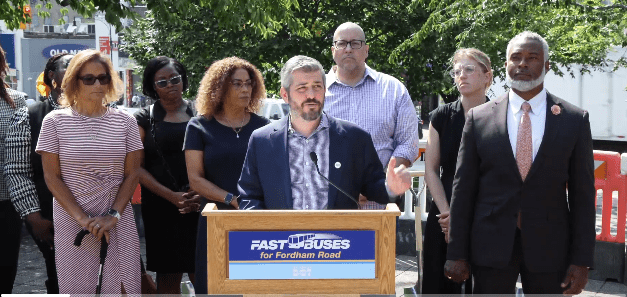
NYC Mayor Zohran Mamdani and NYC Department of Transportation (DOT) Commissioner Mike Flynn broke ground on Wednesday, July 22, on the redesign of Fordham Road, adding new offset bus lanes from Sedgwick Avenue to Boston Road in The Bronx. They said the project will make commutes faster and more reliable for 130,000 daily bus riders while delivering critical safety upgrades on one of the borough’s highest-crash corridors.
“We’re not only promising fast buses, we’re delivering them,” Mamdani said of the launch. “This year, Fordham Road riders won’t have to watch their time disappear in traffic while cars block bus lanes that were meant for people. This project will give 130,000 New Yorkers faster, more reliable commutes every day so they can spend more time doing what they love and less time stuck in traffic.”
City officials said today, buses on Fordham Road travel as slowly as 5 mph, with existing curbside bus lanes frequently blocked by deliveries and passenger pick-ups and drop-offs. They said the City will convert those curbside lanes into offset lanes that better separate buses from general traffic while creating dedicated parking and loading spaces to support local businesses. According to DOT, Fordham Road is one of the busiest bus corridors in the City, intersecting with many other key bus and subway lines.
Source: TrafficStat
They added that similar redesigns across the city have increased bus speeds by as much as 28% while reducing pedestrian and cyclist injuries by as much as 30%. Officials said in Fordham, 62% of households do not have access to a private vehicle, and 71% of residents rely on public transit, biking or walking to get around.
In February, the mayor announced the City would restart work on the Fordham Road redesign after what were described as years of delays under the previous administration. Construction begins weeks after the release of Next Stop, the City’s partnership with New York State to shorten commutes by up to six minutes across 175 bus routes, including Fordham Road.
The mayor, commissioner and MTA Chairman Janno Lieber described the project as critical to deliver a better and faster bus service for New Yorkers, and are aiming to improve bus speeds by at least 20% along the corridor. Since January, City officials said the Mamdani administration has advanced major projects to speed up buses across the five boroughs, including at 161st Street and Tremont in The Bronx.
Source: TrafficStat
During the latest iteration of the redesign project presented in May 2026 to Bronx Community Board 7 (CB7), DOT officials said DOT began its outreach on the Fordham Road project in 2019, between 2020 and 2023, outreach, analysis and design continued and two merchant surveys and numerous street intercept surveys were carried out in the Fordham Business Improvement District (BID) and in the Belmont BID commercial districts.
An Association for a Better New York (ABNY) telephone survey of area residents was also carried out along with over 40 meetings to collect feedback, alongside elected officials, community boards, a community advisory board, and other community organizations. Meanwhile, DOT conducted extensive traffic analysis to determine the project extents and design. The department then selected and proposed the offset bus lane design. Between 2023 and 2026, the current Fordham Road bus service performance has been tracked and evaluated.
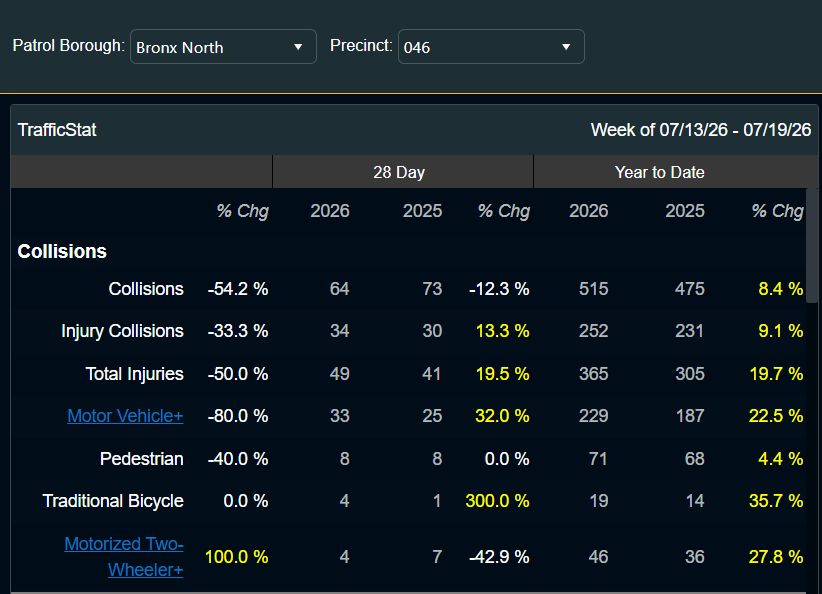
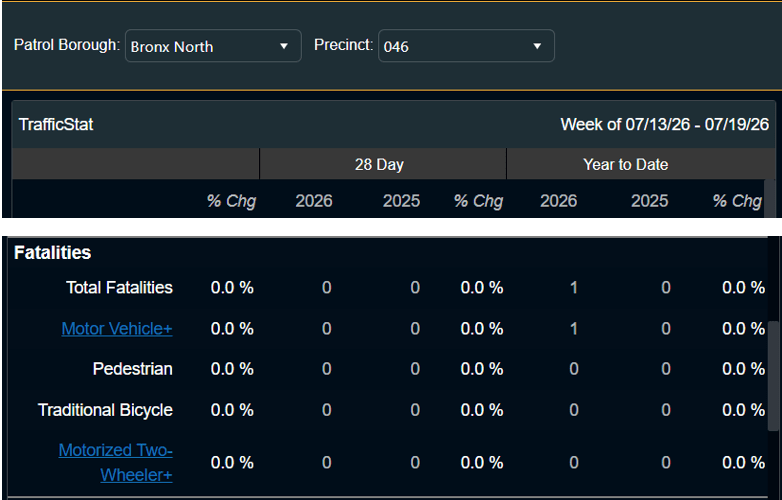
DOT found that Fordham Road is in the top 10% of most dangerous corridors in The Bronx, with 70 serious injuries and four fatalities in the past 5 years. They said DOT’s planned project upgrades will better separate buses from traffic and provide new dedicated spaces to support commercial activity, while also providing the opportunity to enhance the public realm and improve traffic safety.
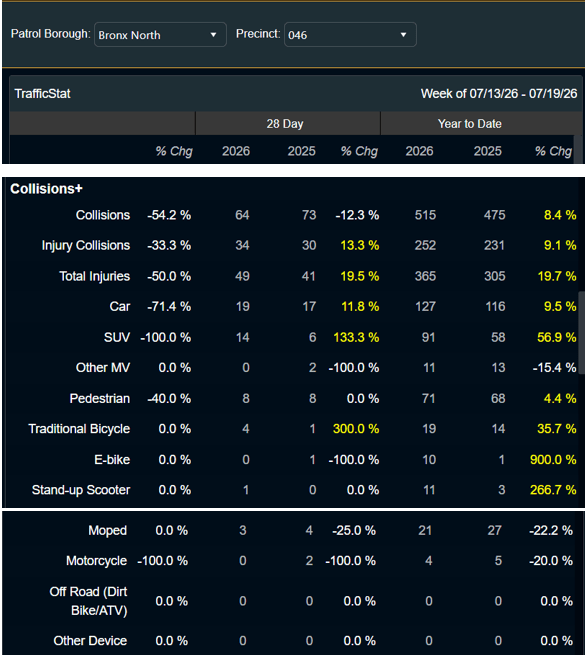
Source: TrafficStat
“The Fordham Road redesign will deliver faster, more reliable public transit for the everyday New Yorkers who depend on it most,” said Congressman Adriano Espaillat (NY-13) in part, while State Sen. Gustavo Rivera (S.D. 33) said in part, “These upgrades will make roads in my district safer for drivers, commuters and pedestrians.”
In April, the DOT Public Engagement Unit visited 217 businesses along Fordham Road, and DOT officials said the businesses shared information about their delivery timing . DOT informed the businesses about the design and got feedback about their curb use needs. They said 60% of surveyed businesses reported receiving deliveries in the existing curbside bus lane and added that the proposed design will create new loading zones available throughout the day, which will be separated from the bus lane.
In terms of how curb regulations will change based on the redesign, DOT said between Sedgwick Avenue and Hoffman Avenue, DOT will update the curb regulations to reduce double parking and conflicts with the bus lane, improve access to businesses, and prioritize commercial vehicle access on Fordham Road and adjacent streets. They said planned parking regulations will be tailored to each block and include a mix of commercial vehicle and passenger vehicle regulations that will vary by location and time of day.
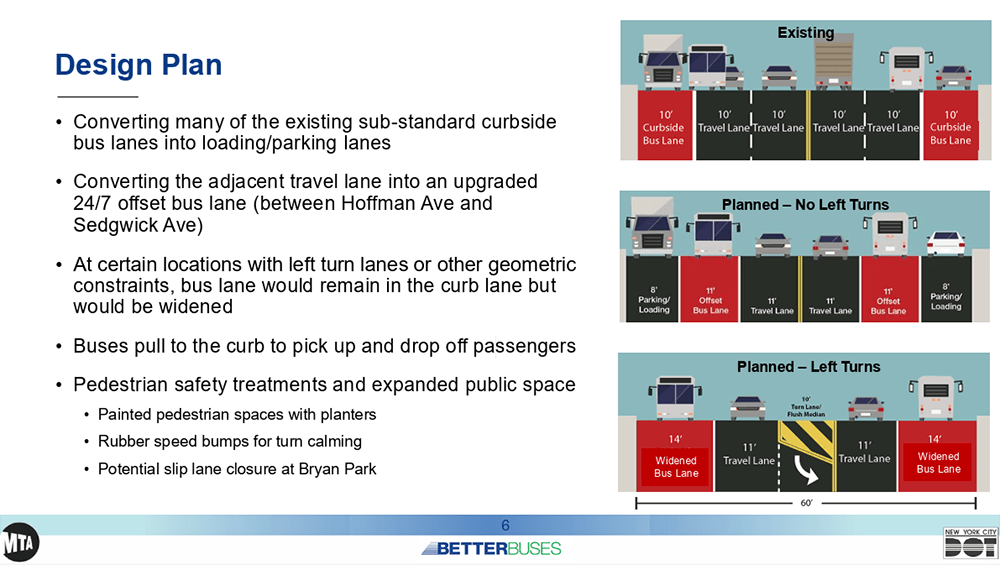
Slide courtesy of DOT
They gave an example of 60-foot commercial vehicle parking, with the rest of the block reserved for metered parking for passenger vehicles. Another example included devoting an entire block for commercial vehicle parking in the morning, and switching to passenger vehicle metered parking in the afternoon.
Meanwhile, City Councilman Oswald Feliz (C.D. 15) had said ahead of the groundbreaking, “The bus lane project presents an opportunity to make transformative investments on Fordham Road, the busiest commercial corridor in The Bronx. It is disappointing that, rather than making meaningful investments, the administration has chosen to offer crumbs.”
Feliz continued, “This community has consistently asked for basic investments that only DOT can provide, the paving of roads, improved street signs, and spaces for pedestrians, greenification of medians, and more lighting. They scheduled meetings with no purpose other than creating the appearance that they’ve listened to the community. Rather than seeking to resolve local issues, they’ve repeatedly created obstacles. For instance, they stated they couldn’t plant trees and greenify street medians on Fordham Road, due to DEP-related concerns. When we reached out directly to DEP, they stated the greenification wouldn’t create any issues for them.”
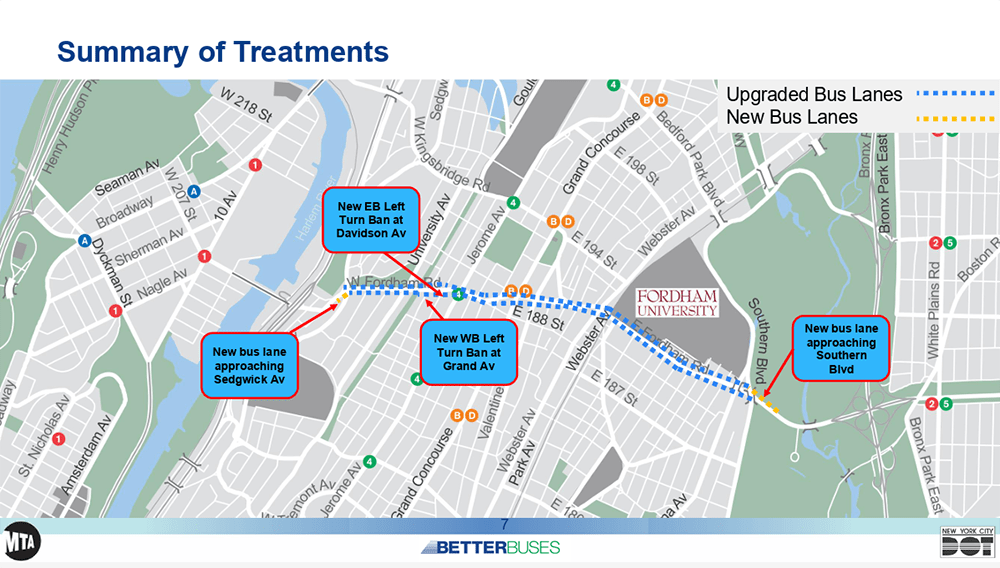
Slide courtesy of DOT
Feliz concluded, “Is this community not trendy enough to justify the kind of improvements that other communities receive, even without asking? If this was a trendier neighborhood, I have no doubt that a more ambitious proposal would have been on the table.” Norwood News has reached out to the Mayor’s Office and DOT for comment. Flynn responded, saying the department had heard the concerns of local stakeholders and some electeds.
“They say [bus lanes are] one thing. There’s a lot of other things that we’d like to see in terms of the streetscape, in terms of pavement, signage and trees. We hear that loud and clear. I don’t think one precludes the other. In fact, they’re complementary. Right now, we are moving ahead with the toolbox we can do through a bus project. We’re having those conversations and I’m excited to sit down and learn more about what else we can do.”
He added, “We’re committed to trying to deliver world-class streets to The Bronx. The Bronx deserves it and it’s what it’s going to get. This project is going to deliver a piece of that, and there will be more to come.”
Meanwhile, while she supports the focus on the project, Councilmember Pierina Sanchez (C.D. 14) said in part, “I remain concerned that reintroducing parking to a roadway that has operated without it for nearly two decades will reduce available travel space and create additional conflict among buses, pedestrians, delivery vehicles, cyclists, and drivers in one of the busiest transit corridors in New York City.”
She added in part, “I have encouraged the Department to prioritize improvements that strengthen bus operations, including wider bus lanes, painted medians, and targeted loading zones. At a minimum, any curb access should be limited to carefully managed loading, unloading, and passenger drop-offs with short, strictly enforced time limits.”
For more recent transit-related news, click here.

admin
Welcome to the Norwood News, a bi-weekly community newspaper that primarily serves the northwest Bronx communities of Norwood, Bedford Park, Fordham and University Heights. Through our Breaking Bronx blog, we focus on news and information for those neighborhoods, but aim to cover as much Bronx-related news as possible. Founded in 1988 by Mosholu Preservation Corporation, a not-for-profit affiliate of Montefiore Medical Center, the Norwood News began as a monthly and grew to a bi-weekly in 1994. In September 2003 the paper expanded to cover University Heights and now covers all the neighborhoods of Community District 7. The Norwood News exists to foster communication among citizens and organizations and to be a tool for neighborhood development efforts. The Norwood News runs the Bronx Youth Journalism Heard, a journalism training program for Bronx high school students. As you navigate this website, please let us know if you discover any glitches or if you have any suggestions. We’d love to hear from you. You can send e-mails to norwoodnews@norwoodnews.org or call us anytime (718) 324-4998.