



Photo by David Greene
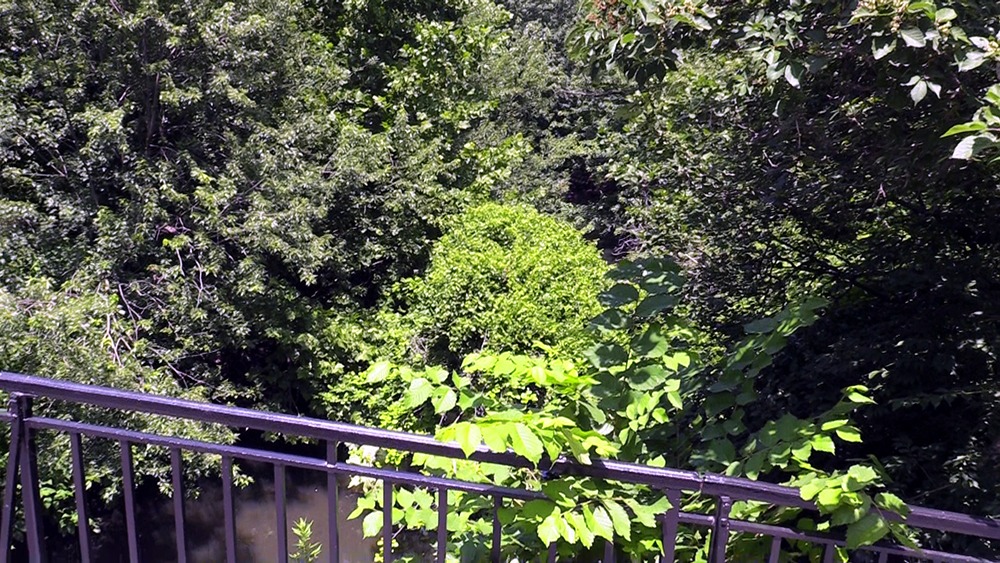
Unsupervised teens and pre-teens continue to head down a footpath beyond the Burke Avenue Bridge that connects the neighborhoods of Norwood and Allerton, where they continue to cool off in the murky water despite the potentially unseen dangers of glass and submerged debris, as well as possible toxins in the water.
Little in the way of safety has seemingly changed since a pair of 2024 Norwood News stories on teens swimming in the area were last published. A visit to the river on Thursday, July 2, found four teens, two girls and two boys estimated to be between 13 and 15, walking down the footpath known as the Bronx River Forest, towards the river. The two girls were observed carrying towels as the temperature peaked at nearly 100 degrees. They carefully made their way onto the rocks at the water’s edge and were soon seen splashing and playing with a floatation device.
Norwood News asked one of the girls if the water was cold. “It’s hot,” she replied. Asked if she was concerned for her safety given there were no lifeguards at the river, the girl simply said, “No.” Another girl was seen using another floatation device as two younger boys, who looked no older than 10 or 11, were observed a short distance away by themselves playing in the water with a soccer ball.
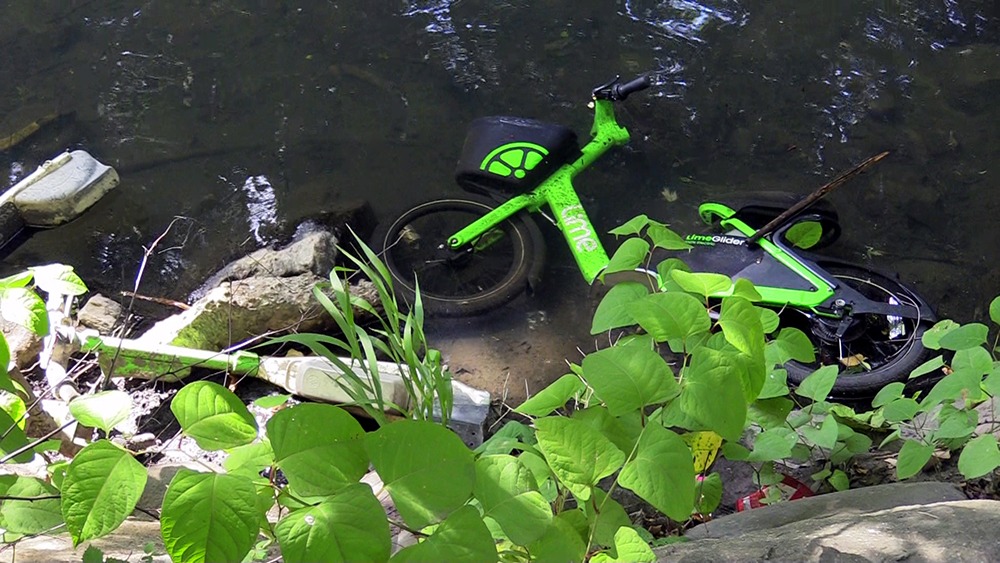
Photo by David Greene
A second girl was asked if she was a good swimmer. “Yes,” she said. Norwood News asked if she knew that the water was not clean. She responded, “I know.” The young girl said it was her second time this year swimming in the Bronx River, adding that she had visited another point on the river north of her latest swim spot.
After learning of the teens swimming in the area but unable to see them frolicking in the water 100 yards from the footbridge, due to overgrown trees, “Zhane,” a young woman and longtime resident of Allerton, told Norwood News, “First of all, they shouldn’t even be swimming in this. That’s nasty.” She continued, “Yes, it’s disgusting; this isn’t for public swimming.”
Zhane said she believed the isolated area could have more Parks and NYPD patrols. “Back here is bad,” she said. “I’m not going to lie.” She said given it’s a short cut but also secluded, people should be pay attention for their own safety if walking in the area. She added in relation to the youngsters swimming in the river, “What they’re doing is not safe at all; you never know what’s going to happen.”
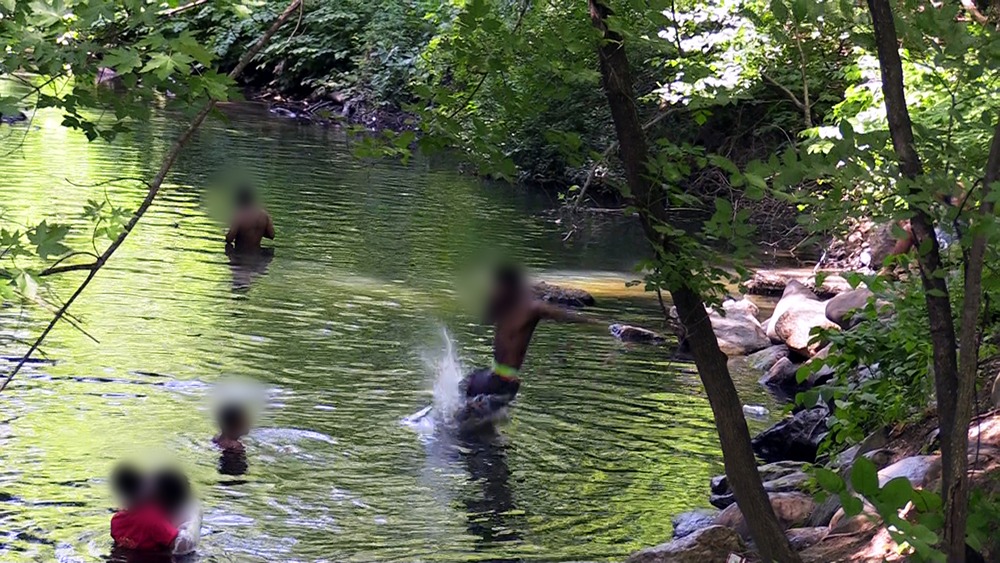
Photo by David Greene
A visit to the river on Saturday, July 4, found a half dozen older teens swimming and jumping into the river, all while the water’s edge was littered with at least one wine bottle and some empty beer containers. An e-bike was also seen partially submerged in the water.
Norwood News made two requests for comment on the unsupervised swim with the NYPD. We did not receive a response. In 2024, an unnamed NYPD official had told Norwood News, “There are no designated patrols for swimming in those areas of the 52nd Precinct.”
New York City Parks’ department did respond to our requests for comment, insisting that Parks’ enforcement officers routinely patrol the area. As of July 22, they said they had not received any complaints about swimmers in the Bronx River. Parks did concede that on two occasions in early July, swimmers were discovered at the location and were removed from the water by Parks Enforcement Police officers (PEPs).
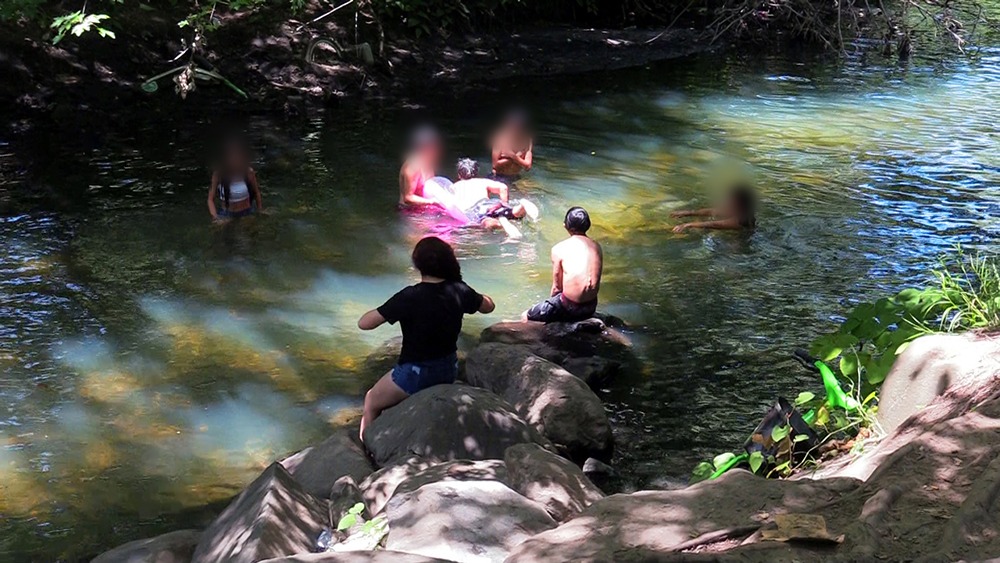
Photo by David Greene
The Parks Department also said that PEP officers’ first course of action is to educate but that they can also issue summonses, as necessary. As of July 22, they said PEP officers had not issued any summonses for unauthorized swimming so far this year in The Bronx. Parks officials also said that “no swimming” signs are posted at the Burke Avenue Bridge as well as other locations along the river.
In order to seek comment on the possible health dangers of swimming in the Bronx River, Norwood News also reached out to the New York City Department of Environmental Conservation (DEC) and was informed by DEP / NYC Water? official, Deja Stewart, that this particular section of the Bronx River falls under the jurisdiction of New York State Department of Environmental Conservation (NYS DEC) and directed questions on the water quality to them.
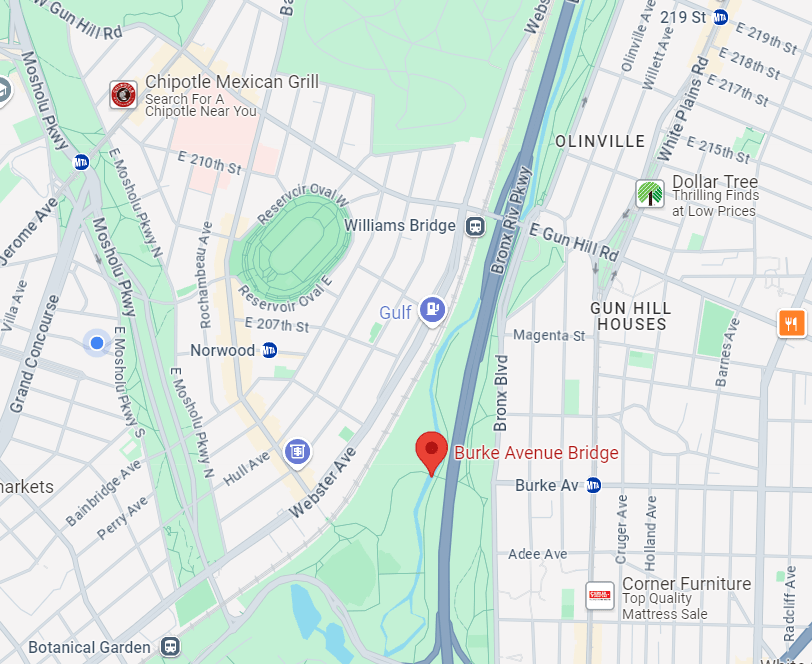
Image courtesy of Google Maps
On Tuesday, July 21, Adanna Roberts at the NYS DEC replied, “I’m working on this inquiry for you.” We did not receive a response as of press date.
Meanwhile, Javier Lopez, interim executive director of the Bronx River Alliance, said of the swim, “To be unequivocal, the Bronx River is not safe for swimming under any circumstances.” He continued, “Beyond physical dangers like hidden submerged debris and unpredictable currents, the river poses significant health risks due to water quality.”
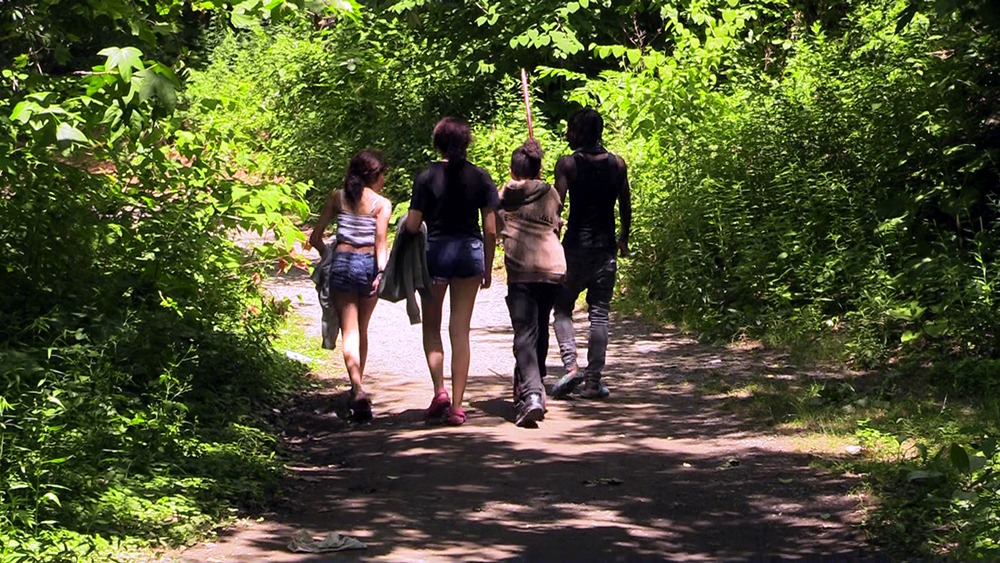
Photo by David Greene
Explaining the potential dangers, Lopez added, “During rain events, Combined Sewer Overflow systems and aging sewer infrastructure release untreated sewage and contaminated runoff into the river. This is compounded by periodic upstream industrial contamination, such as dielectric fluid spill in Yonkers this past April.” He added that contact or ingestion of the water can cause skin irritation, gastrointestinal illness and other infections.
“We urge everyone, even experienced swimmers, to stay out of the water,” Lopez said, concluding, “For decades, the Bronx River Alliance, alongside community partners, local advocates, and federal supporters, has worked tirelessly to transform the river from an industrial dumping ground into a thriving, living waterway. While we have made tremendous progress reviving ecosystems and expanding safe public access like guided paddling, repeated pollution events threaten to undo years of hard work and recovery.”
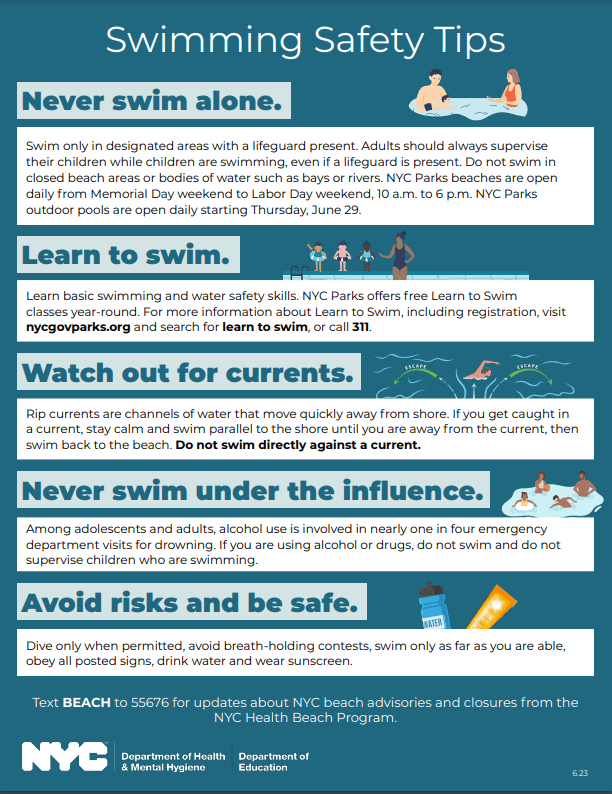
Flier coutesy of NYC Department of Health & Mental Hygiene
According to the latest statistics from the New York State Department of Health (NYS DOH) in 2024, there were 234 drownings at “regulated” facilities in New York City between 1987 and 2024. Of those drowning incidents, 123 people died by drowning at a pool, and 111 drowned at area beaches. New York City reported six drownings in 2024, three at pools and three at area beaches. In 2023, there were three drownings, all at regulated pools. New York City currently averages 6.16 drownings per year.
According to NYS DOH, there are over 7,400 public swimming pools and 1,300 public bathing beaches in New York State. As shared by Norwood News previously, NYC Parks has a free “learn to swim” program where swimmers are selected by lottery. For more information visit https://www.nycgovparks.org/events/learn-to-swim.
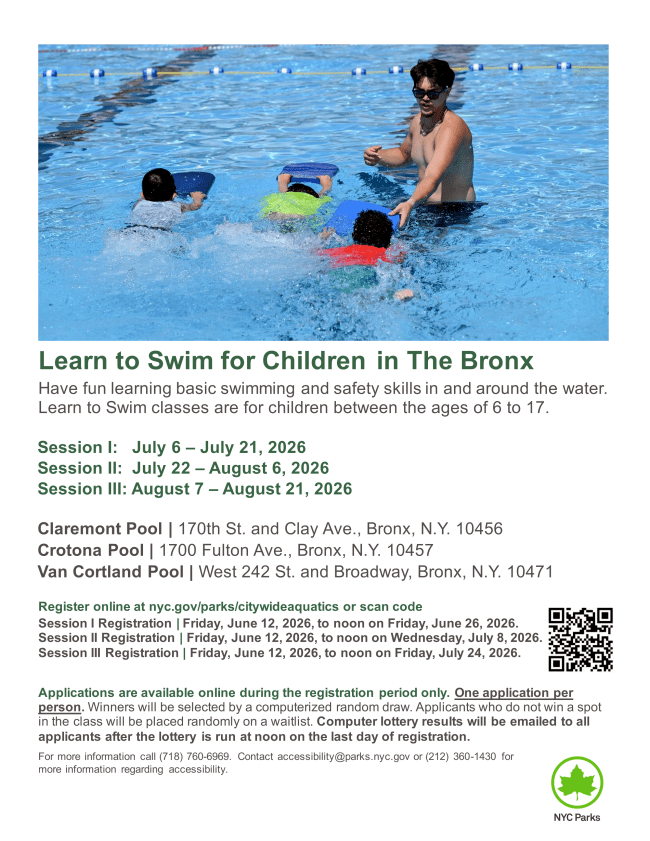
Flier courtesy of NYC Parks
REGULATED SWIMMING POOLS:
NYC Parks Van Cortlandt Park Pool, West 242nd Street and Broadway, Bronx open from 11 a.m. to 7 p.m. daily, with pool cleaning between 3 p.m. and 4 p.m. Phone: (718) 548-2415.
NYC Parks Mapes Pool, East 180th Street between Prospect Avenue and Mapes Avenue, Bronx open from 11 a.m. to 7 p.m. daily with pool cleaning between 3 p.m. and 4 p.m. Phone: (646) 823-5185.
NYC Parks Crotona Park Pool, East 173rd Street and Fulton Avenue, Bronx 11 a.m. to 7 p.m. daily, with pool cleaning between 3 p.m. and 4 p.m. Phone: (646) 581-7535 or (718) 299-0791.
The Carolyn McLaughlin Community Center (indoor) Pool at BronxWorks, 1130 Grand Concourse, Bronx between East 167th Street and McClellan Street. Phone: (212) 725-0939.
For additional pool listings visit: https://www.nycgovparks.org/facilities/outdoor-pools.

admin
Welcome to the Norwood News, a bi-weekly community newspaper that primarily serves the northwest Bronx communities of Norwood, Bedford Park, Fordham and University Heights. Through our Breaking Bronx blog, we focus on news and information for those neighborhoods, but aim to cover as much Bronx-related news as possible. Founded in 1988 by Mosholu Preservation Corporation, a not-for-profit affiliate of Montefiore Medical Center, the Norwood News began as a monthly and grew to a bi-weekly in 1994. In September 2003 the paper expanded to cover University Heights and now covers all the neighborhoods of Community District 7. The Norwood News exists to foster communication among citizens and organizations and to be a tool for neighborhood development efforts. The Norwood News runs the Bronx Youth Journalism Heard, a journalism training program for Bronx high school students. As you navigate this website, please let us know if you discover any glitches or if you have any suggestions. We’d love to hear from you. You can send e-mails to norwoodnews@norwoodnews.org or call us anytime (718) 324-4998.