



Photo by Síle Moloney
On reviewing the various development projects in the North Bronx ahead of the final edition of the Norwood News after 38 years, the first thing that comes to mind in some but not all cases is, of course, just how seemingly arduous and protracted they can be.
Often surpassing the durations of successive gubernatorial and mayoral administrations, and the tenures of various politicians, hopes are riding high that the White Plains Road Neighborhood Plan will not fall to the same fate as the Croton Water Filtration Plant and the Kingsbridge Armory in terms of duration.
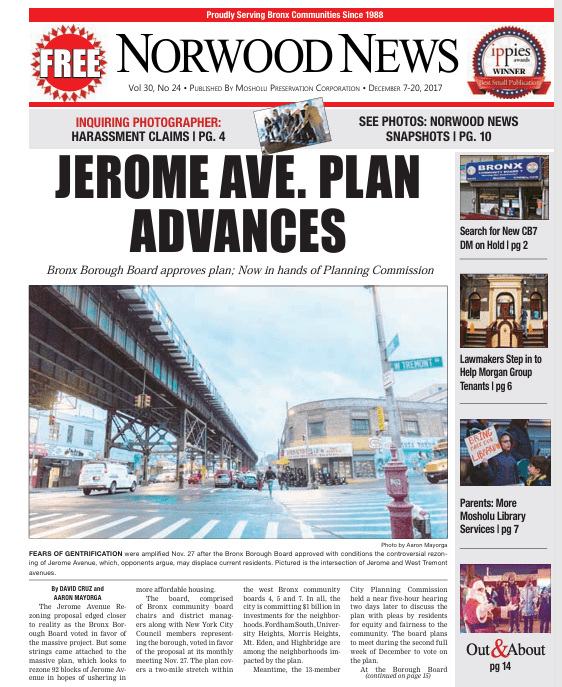
Norwood News reported on a similar Bronx commercial corridor revitalization in the form of the Jerome Avenue rezoning. As reported, in 2018, the City Council approved the rezoning of a 92-block stretch of Jerome Avenue from 165th to 183rd streets. This was much to the chagrin of housing activists who believed that despite concessions made in the plan to protect local auto body shops and existing affordable housing, the rezoning would ultimately instigate the displacement of low-income residents.
Similar concerns had also been raised at one point by local small business owners located close to the Kingsbridge Armory in the context of its redevelopment.
The Jerome Avenue rezoned area would span from Highbridge to University Heights, impacting Bronx neighborhoods represented by Bronx Community Boards 4, 5, and 7. Norwood News covered the process since its 2015 proposal, including the plan’s approval by the City Council’s Land Use Committee on March 6, 2018, and the effects upon its ratification. To read more on the rezoning history, click here, here, here, here, here, here, here, here, here.
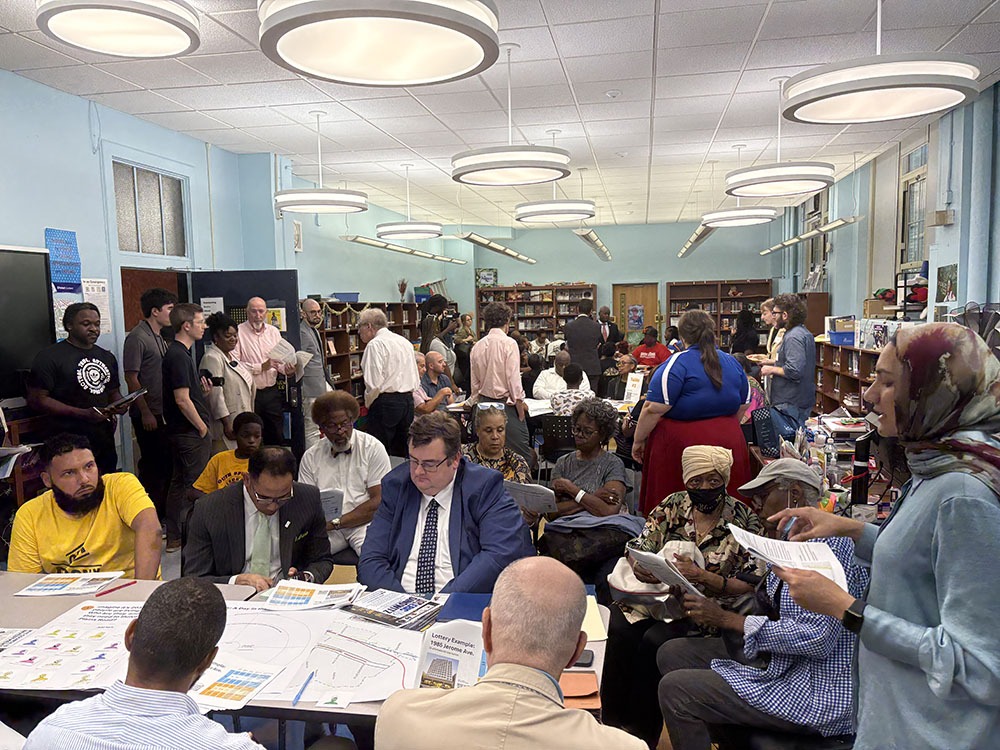
Meanwhile, a Goals Workshop to discuss the White Plains Road Neighborhood Plan was hosted by NYC Department of City Planning (DCP) on Aug. 18 at a local Williamsbridge high school, and was attended by DCP Commissioner Sideya Sherman, various residents, as well as Councilman Kevin Riley (C.D. 12) and Councilman Eric Dinowitz (C.D. 11).
DCP officials said that since 2023, the City has been experiencing its lowest average vacancy rate (housing availability) since 1968, at 1.41%, and that in The Bronx, it’s even lower at 0.82%. It was also confirmed that more than half of residents in Bronx Community District 12, covering Wakefield, Williamsbridge, Woodlawn, Olinville, Eastchester, and Edenwald-Baychester, are paying almost a third or half of their income on rent and that the Bronx population has grown by 6.1% from 2010 to 2020.
The purpose of the workshop was to obtain feedback from residents of what White Plains Road should look like in 2035. Retaining the cultural identity of the area was among the priorities. Elected officials emphasized the importance of residents being involved in the decision-making in terms of housing and development.
Riley said it was a very extensive process. “We’re taking as much time as possible to educate the community,” he said. “I think with something as dense as a neighborhood plan, when you’re bringing it to the area, a lot of people have their concerns. A lot of people have recommendations. A lot of people have their worries on what’s actually coming here. Even when we were over there at the table, somebody was like, ‘How do you guys mandate that MIH [mandatory inclusionary housing] will be utilized from a developer?'”
Screenshot by Síle Moloney
He continued, “So we’re taking this time to really educate the community on this neighborhood plan that’s coming to the area. I think that’s the first step. The second step is to get as much recommendations as possible. Like myself, who has grown up in this area my entire life, utilize White Plains Road for a lot of different things. I think we want to see a lot more possibilities. A lot of people want to dine on White Plains Road. A lot of people are talking about yoga studios on White Plains Road, skating parks. We’re talking about community centers. We’re talking about facilities that a lot of people can work in, a health facility, educational institution, maybe a college coming in.”
Riley said there were a lot of different suggestions from residents and that they were working with the Mamdani administration, with DCP, Dinowitz, the community board and advisory group and others on the plan. “You can see how many people came out today,” he said. “We have all different stakeholders that are part of this process, so we’re looking forward to it. We know, at the end of the road, this is going to be something that we’re all going to be proud of.”
Norwood News asked the councilman how much the delay with the upcoming East Bronx Metro North access plan was factoring into the discussions. “The delays are extremely frustrating, but we know it’s coming. At least we know it’s coming,” the councilman said. “This process is going to take some time as well. So I think in fruition, where we’re talking about adding more transportation opportunities here in the Northeast Bronx, with the combination of adding this neighborhood plan, you’re going to see an entire Northeast Bronx that’s going to be rejuvenated, revitalized, and reinvested into.”
He continued, “So I think when you have those three components, it’s something that’s extremely important. So yes, the delays are extremely frustrating, but we know it’s coming. At least we know it’s coming. Before it was an impossibility. We were pushing for it, but now we definitely know it’s coming. So we’re going to work on the delay aspect of it, but looking forward to having this neighborhood plan be attached to that.”
For his part, addressing those gathered, Dinowitz said often the plans for rezonings discussed at city council come from developers who want to build housing, adding that that was great, but how it was important that residents also were part of the decision-making process. “What I love is this: is all of you coming here, the Department of City Planning, here with us, working for months and months and months, the city council land use team being here, people from all walks of the community, different parts of the neighborhood coming together to make their voices heard.”
He said it shouldn’t be up to developers to determine what neighborhood look like. “It shouldn’t be up to some bureaucrats in an office downtown to determine what our neighborhood looks like,” he said. “It should be up to all of us, and that’s what your participation tonight, for the past few months has been. It has been us taking hold and taking ownership of our community.” He thanked DCP and all involved for their work on the plan.
Norwood News later spoke to the DCP commissioner and asked her what, in her opinion, were the main challenges when it comes to development in The Bronx, as a whole, and in the North Bronx in particular or if they were same or similar to challenges in other boroughs. “I think The Bronx has been a leader in terms of developing housing across our city, particularly in the South Bronx,” Sherman said. “We’ve seen that for many, many years, right? And that’s been crucial to making sure that people can stay in their communities, stay in their cities.”
She continued, “But when you get to communities like White Plains Road in the Northern Bronx, there’s a different characteristic, right? There’s single-family homes, multifamily homes, there’s small apartment buildings, right? It’s a unique neighborhood character, and so part of what we’re trying to accomplish through this planning exercise is to figure out a way to grow that smart for the community. That helps reduce some of the burden of costs that people are dealing with, adds much-needed housing, because we know people want to continue to grow their families and live in this neighborhood, and continues that trend of The Bronx continuing to add housing, but affordable housing in particular.”
Norwood News asked if she saw that as being standalone housing or if there was a preference for apartments, or a mixture of both. “So, our focus in this study is primarily the White Plains Road corridor, which is really a corridor that would support apartment buildings, multi-level apartment buildings, along with retail, which is really, really critical because it’s a major commercial corridor for our city, and so you know there’s an opportunity to figure out how we maximize opportunity along the corridor. It’s so well connected to transit. You have the 2 and the 5 train. You’re not far from the Metro North. People can get in and out very, very quickly and around The Bronx quickly.”
We highlighted that this was not the case from east to west across the borough. “I know that’s a challenge,” Sherman said. “Yes, but people can certainly can get to the train, and so we want to take that opportunity. But what we also want to do is make sure that we’re creating opportunity to map mandatory, inclusionary housing in this community, which we’ve not been able to do, and so through this exercise, which would be a comprehensive neighborhood plan, it would also allow us to really mandate affordable housing within this community, so that is here for generations.”
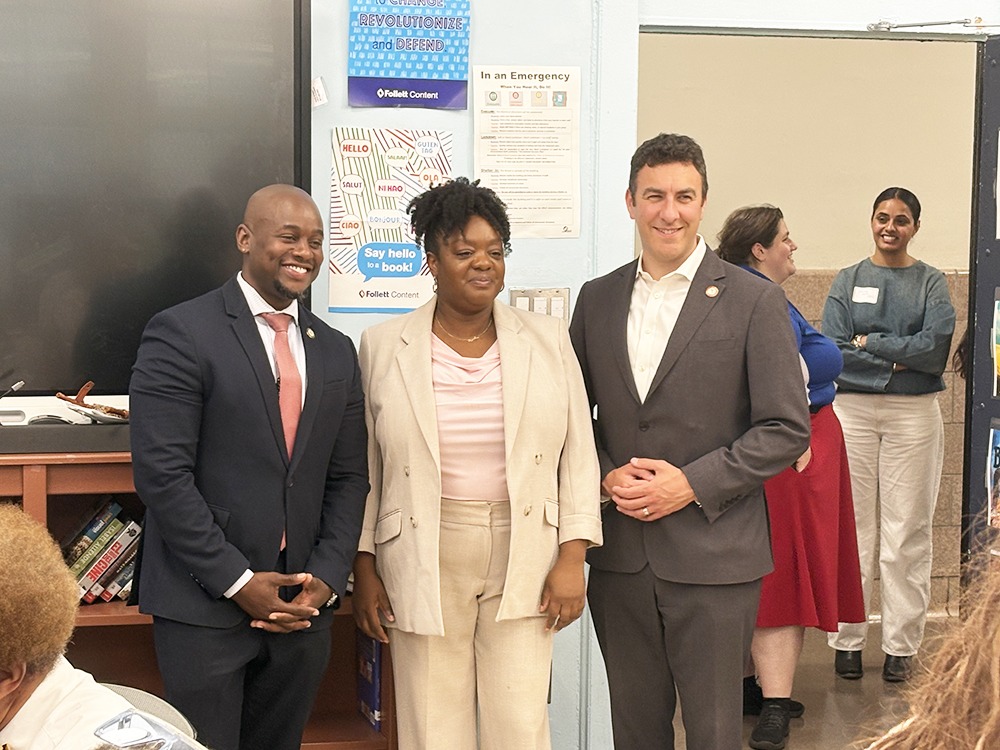
Photo by Síle Moloney
Norwood News mentioned the prior pushback by some in the community, not necessarily in terms of general housing, but to types of supportive housing on the grounds of Jacobi Hospital [Just Home project] for formerly incarcerated people with mental illnesses and asked the commissioner if she anticipated similar pushback in terms of the White Plains Road Plan, depending on the eventual housing mix.
“I would say that starts with what we’re doing today, right?” she said. “It’s conversations with communities, understanding people’s needs, and working collectively to address them, and also understanding the needs of our city as a whole, right? We have needs of housing. We have housing needs of all types, for all types of people, and so it’s critical that we’re listening to local communities, and we’re also keeping sight of the many people who need homes in our city, and also are looking to find a place to live. I think that that’s the kind of mix that you can build in any neighborhood when you have a process that leads to that type of comprehensive vision.”
The commissioner added that an online Voice Divisions tool was also a way for people to submit feedback on the plan and that on the wishlist were things like open spaces, safe streets, and “all the other things that go along with housing [that] are important.”
Asked if there was anything about The Bronx in particular that made it different in terms of approach from the rest of the city, from a planning perspective, Sherman said, “Yeah, every neighborhood’s unique, and so I think every community we approach with wanting to first understand the unique characteristics of the neighborhood, the built environment of the neighborhood, but also what the priorities are. And while many of the priorities across New York are the same, you know, obviously affordability being the big one, we know that there are things that make up every unique neighborhood.”
She referenced the need for cultural identity preservation. “We know that across the city, and in the mayor’s block-by-block plan, we’ve been focused on making sure that we’re increasing housing production across New York City,” Sherman said, adding that the focus was on transit corridors but also “listening closely to communities to understand the things that make their neighborhoods unique, so that we’re planning in that context.”
Other major development projects in the North Bronx to keep an eye on are the Old Fordham Library, located at 2556 Bainbridge Avenue in Fordham Manor, on which a town hall was held in April 2025 with Council Member Oswald Feliz (C.D. 15), Loews Paradise Theater on the Grand Concourse, and of course the ongoing, various housing developments taking place around Webster Avenue and Bedford Park Boulevard, including a proposed new dormitory for Fordham University students.
To read some but not all of our prior development-related stories, click here, here, here, here and here.

admin
Welcome to the Norwood News, a bi-weekly community newspaper that primarily serves the northwest Bronx communities of Norwood, Bedford Park, Fordham and University Heights. Through our Breaking Bronx blog, we focus on news and information for those neighborhoods, but aim to cover as much Bronx-related news as possible. Founded in 1988 by Mosholu Preservation Corporation, a not-for-profit affiliate of Montefiore Medical Center, the Norwood News began as a monthly and grew to a bi-weekly in 1994. In September 2003 the paper expanded to cover University Heights and now covers all the neighborhoods of Community District 7. The Norwood News exists to foster communication among citizens and organizations and to be a tool for neighborhood development efforts. The Norwood News runs the Bronx Youth Journalism Heard, a journalism training program for Bronx high school students. As you navigate this website, please let us know if you discover any glitches or if you have any suggestions. We’d love to hear from you. You can send e-mails to norwoodnews@norwoodnews.org or call us anytime (718) 324-4998.