



Photo courtesy of the government the State of New York
They said in addition to the completed work, another 126 elevators, 105 heating systems, and 29 façades are currently under construction, with further upgrades in design and procurement stages. They said these additional projects, comprising 172 elevators and 59 façades, will bring the total benefit to approximately 123,000 residents across 75 NYCHA developments.
They said the funding stems from three agreements since 2021 and has been supplemented by a new $365 million allocation as part of the Financial Year 2025 and Financial Year 2026 budgets.
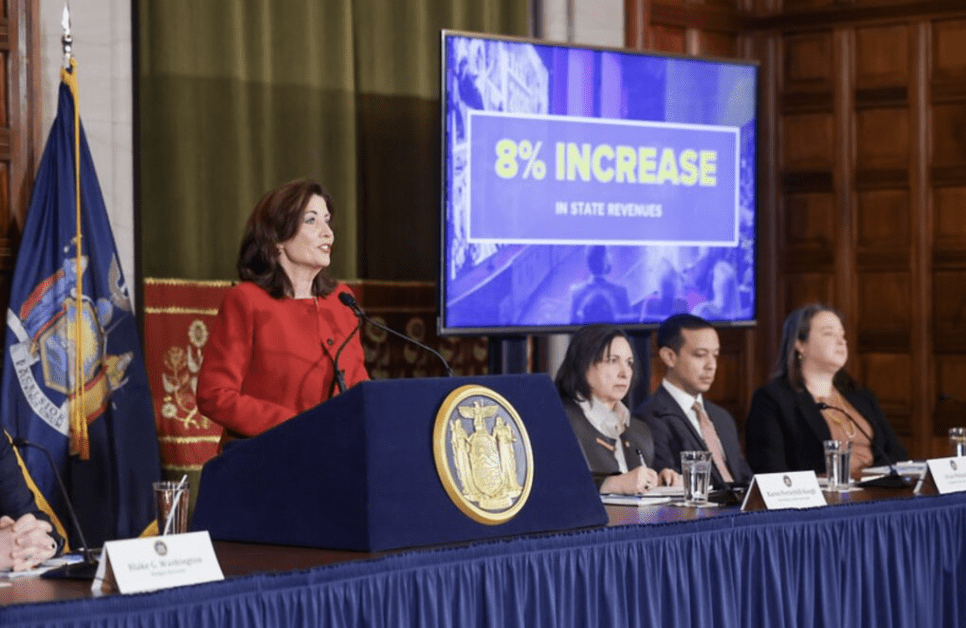
Hochul said in part, “NYCHA residents deserve access to a safe, affordable, and accessible place to live, and these improvements are critical to making that reality. I am proud to partner with NYCHA, its residents, and local and State officials to support NYCHA communities.”
For his part, Adams, who as reported, is now in the throes of a hotly contested reelection campaign as an independent and former Democratic candidate, said, “We are proud to call ourselves the most pro-housing administration in New York City history, and that includes public housing. From unlocking over $4.7 billion for capital repairs through the PACT program to delivering free internet to over 150,000 NYCHA households through our Big Apple Connect initiative, we are putting public housing first every day.”
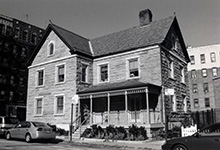
NYCHA’s “Northwest Bronx Scattered Sites” include Bailey Houses, Fort Independence Houses, East 180th Street-Monterey Avenue, Harrison Avenue Rehab A and B, Twin Parks East (Site 9), University Avenue Rehab, and West Tremont Avenue-Sedgwick Avenue Area. According to NYCHA, Bailey Houses and Fort Independent Houses were among the developments selected to be a part of the PACT (Permanent Affordability Commitment Together) program in July 2023.
The mayor added, “These renovations will help tens of thousands of NYCHA residents stay safe, stay warm, and stay healthy. Thank you to the State for funding these critical upgrades and to all our NYCHA leaders for their tireless advocacy on behalf of our public housing tenants.”
Meanwhile, Bova-Hiatt said, in part, that NYCHA had made tremendous progress “in the face of decades of federal disinvestment.” She said the support of partners at the State had been integral as it continued working to improve building infrastructure and make much-needed capital improvements across the portfolio. “We deeply appreciate the State‘s ongoing dedication to all the New Yorkers who call NYCHA home,” she said.
Government officials said specific developments receiving improvements include Unity Plaza in Brooklyn, which saw new elevators installed, and the Pink Houses, where heating system upgrades were completed. Other upgrades were carried out at Pelham Parkway Houses in The Bronx, Queensbridge North in Queens, and multiple properties in Manhattan, including Douglass I, Douglass II, and the Thomas Apartments.
The news was welcomed by various Bronx elected officials, including State Sen. Jamaal T. Bailey (S.D. 36), the current Bronx Democratic Party chair, who said, “This milestone reflects our unwavering commitment to providing safe, healthy, and modern homes for NYCHA residents across the five boroughs.”
He added, “With the support of $1.2 billion in essential State funding, vital improvements to elevators, heating systems, and building facades have been made, directly impacting the quality of life for nearly 39,000 New Yorkers. These investments not only address critical infrastructure needs but also reaffirm our mission to preserve housing for generations to come.”
State Sen. Gustavo Rivera (S.D. 33), who represents much of the northwest and center Bronx, said, “I’m thrilled to see State funding finally put to good use for critical infrastructure upgrades at Pelham Parkway Houses and across the city. I’m glad to see this funding prioritized for major capital projects rather than tinkering around the edges of deep-rooted issues.”

Photo by Síle Moloney
Assembly Speaker Carl E. Heastie (A.D. 83) said, “The completion of these projects to make NYCHA properties more accessible and efficient will be an incredible benefit to residents across the city. The Assembly Majority understands the critical need for affordable and reliable housing and will continue to support NYCHA’s efforts to improve facilities so that all residents can thrive.”
Representing the northwest Bronx, Assemblyman Jeffrey Dinowitz (A.D. 81) said he was very excited that the State was able to provide $1.2 billion in funding to help with capital upgrades for dozens of NYCHA developments throughout the city, including Marble Hill Houses in his own district.
“Tens of thousands of residents live in these developments and these capital improvements will have a significantly positive impact on all of them,” Dinowitz said. “I will continue to work with my colleagues in the future so that we can continue to make the necessary improvements in our public housing.”
Meanwhile, on June 24, Rep. Ritchie Torres (NY-15) said regarding needed NYCHA repairs, “I am partnering with @MetroIAF to spread the word about the most powerful tool most NYCHA residents have never heard of: the OCC. If you have mold and leaks and NYCHA won’t fix them, call the OCC [mold and leak Ombudsperson Call Center for residents living in NYCHA-owned buildings.)
“The OCC doesn’t work for NYCHA, it works for you,” Torres said. The number to call is 888-341-7152 and more information can be found on ombnyc.com.
According its X handle, Metro IAF is a collective of broad-based, multi-faith organizations in the northeast, southeast, midwest and in Europe which are developing leaders, strengthening communities and seeking justice.
NYCHA officials said it received a total capital funding allocation of $1.2 billion from New York State through three funding agreements: $450 million for boiler and elevator upgrades in November 2021; $300 million for additional elevator upgrades in April 2022; and $485 million for facade restoration and additional heating system upgrades in December 2023.
They said the State reimburses agencies only after a Grant Disbursement Agreement (GDA) is in place and requisitions that meet the terms of the GDA have been submitted by NYCHA and approved by the DASNY. This may have been mentioned to appease any critics of the agency after it was discovered in February 2024 that in the largest number of federal bribery charges brought on a single day in the U.S. Department of Justice history, 70 current and former NYCHA employees, including eight from The Bronx, were charged with allegedly accepting cash payments from contractors in exchange for awarding NYCHA contracts at various NYCHA locations across the City.
They added that NYCHA mobilizes quickly to initiate projects soon after a GDA is signed. New York State additionally awarded NYCHA $350 million in capital funds in Fiscal Year 2023 and $135 million in Fiscal Year 2024. To date, the State has allocated $161 million in Emergency Rental Assistance Program (ERAP) and $35 million in COVID-19 Rental Assistance Program (CRA) funding to NYCHA to ease rental arrears for residents.
NYCHA officials said elevator service is a key pillar area of the 2019 Agreement with the United States Department of Housing and Urban Development (HUD), and that reducing the length and frequency of service disruptions, and expediting response times, have been focal points of improvement for NYCHA in the time since.
They said much of NYCHA’s elevator stock is beyond the typical useful life of 15-20 years for a multifamily residential property, making elevator replacement and modernization increasingly important, particularly in high-rise buildings, and for seniors and residents with mobility impairments.
They said using State funding, NYCHA has completed elevator assets at Atlantic Terminal Site 4B, Carey Gardens, Coney Island I (Site 1B), Coney Island I (Sites 4 & 5), Unity Plaza (Sites 17, 24, & 25A), and Unity Plaza (Sites 4, 5A, 6, 7, 9, 11, 12, & 27) in Brooklyn; Butler, Highbridge Gardens, and Mitchel in the Bronx; Queensbridge North in Queens; and Richmond Terrace in Staten Island.
They said another key pillar area of the 2019 HUD Agreement is heating service. They said with many of NYCHA’s boilers past their useful lifespan of 25 years, investment in reliable, sustainable, and lower cost heating systems and infrastructure upgrades had become a necessity for the Authority.
They said State funding has allowed for the completion of comprehensive heating system upgrades at Pink Houses in Brooklyn; Marble Hill in the Bronx; 830 Amsterdam Avenue in Manhattan; and Berry Houses in Staten Island. At Marble Hill, they said NYCHA recently completed installation of 6 new, high-efficiency, gas-condensing boilers for space heating and decoupled the hot water heating, serving 2,975 residents across 11 buildings.
Additionally, they said facade renovation alleviates any existing structural damage and water infiltration; ensures compliance with Local Law 11 by identifying and addressing potential hazards from building facades; and improves energy efficiency while enhancing a building’s overall physical aesthetic.
They said using State funding, NYCHA has completed facade renovations to buildings at Jackson and Pelham Parkway in The Bronx; Clinton, Douglass I and II, East River, Thomas Apartments, and Washington in Manhattan; and Bland Houses in Queens. At Douglass I and II, they said NYCHA recently completed facade renovations across 12 buildings and removed sidewalk sheds that had been in place for five to seven years due to unsafe facade conditions, benefiting 3,904 residents.
Portfolio-wide, a physical needs assessment (PNA) released by NYCHA in 2023 estimates the Authority’s total capital needs to be nearly $80 billion, representing the level of funding required to bring developments to a good state of repair and ensure their long-term viability.
For some of our past coverage on the topic of NYCHA, click here, here, here, here, here, here, here, here, here and here.

admin
Welcome to the Norwood News, a bi-weekly community newspaper that primarily serves the northwest Bronx communities of Norwood, Bedford Park, Fordham and University Heights. Through our Breaking Bronx blog, we focus on news and information for those neighborhoods, but aim to cover as much Bronx-related news as possible. Founded in 1988 by Mosholu Preservation Corporation, a not-for-profit affiliate of Montefiore Medical Center, the Norwood News began as a monthly and grew to a bi-weekly in 1994. In September 2003 the paper expanded to cover University Heights and now covers all the neighborhoods of Community District 7. The Norwood News exists to foster communication among citizens and organizations and to be a tool for neighborhood development efforts. The Norwood News runs the Bronx Youth Journalism Heard, a journalism training program for Bronx high school students. As you navigate this website, please let us know if you discover any glitches or if you have any suggestions. We’d love to hear from you. You can send e-mails to norwoodnews@norwoodnews.org or call us anytime (718) 324-4998.