





Photo courtesy of P.S. / M.S. 95 The Sheila Mencher School
Roger Sherman, one of the signers of the U.S. Declaration of Independence, said, “The equitable principles of justice should be the basis of our laws, and the promotion of the public good should be our primary aim.’’
Under the direction of the M.S. 95 The Sheila Mencher School Principal Serge Marshall Davis, the school’s eighth graders explore and address the common trajectory of both equity and social justice, and put them into practice through the school’s “Leaders of Tomorrow” program.
Equity seeks improvement in student learning and access to educational resources with the aim of achieving success. It embraces the concepts of providing suitable opportunities for all students, of acknowledging that all students are of essential value and worth, and that the education of students should be individualized according to their needs.
Social justice is a term that refers to the way society and its institutions look at the fundamental parts of its own composition e.g. in terms of economics, territory, environment, culture, resources, laws, financial institutions, nonprofit societies, health care and, of course, education.
In each sector of society, equity and justice both require fairness. Fairness seeks appropriate support to deliver high-quality education to each student, regardless of the student’s prevailing educational level or financial circumstances.
Resources are needed in order to come up with programs and experiences that eliminate educational deficiencies that hinder students from achieving their full potential. Students are provided with what they, as individuals, need in order to flourish, not just the same, standard “one-size-fits-all” educational programs.
The “Leaders of Tomorrow” program, also known as the Student Council, headed by the school’s academic coach, Andrea Faulkner, focuses on a commitment to community building throughout the school. The goal is to enhance the students’ experiences of fairness, equity, social justice and peace.
“Equity and justice manifest themselves in so many ways at P.S./M.S. 95,” Faulkner said, adding that there are many forums in which students can participate to enhance educational equity and ultimately be successful, both inside and outside the classroom. Some of these include in sports, the arts, on educational trips for all grades, at poetry slams, as well as in academics and music.
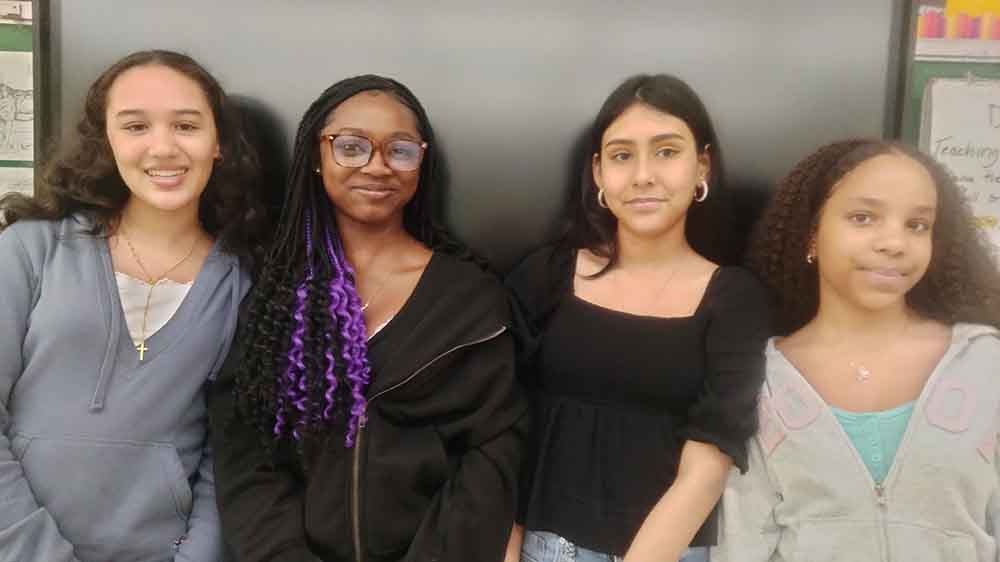
Photo courtesy of P.S. / M.S. 95 The Sheila Mencher School
Through the “Leaders of Tomorrow” program, the participating students from M.S. 95 are trained to become leaders and to learn justice through peer mediation, following certain protocols. They learn how to form advisory committees, to listen, to be objective, to discover the root of a problem, and to know that there is a theoretical stepladder that can be used to find solutions to problems.
The jewel of teaching equity and social justice is also the Thurgood Marshall program, run by the Bronx Supreme Court, in which students, under the guidance of practicing lawyers, participate in mock legal trials, analyzing both sides of a case and arguing each side. Participants take trips to the Bronx County Courthouse to see live trials in action and have even enjoyed the rare opportunity to see U.S. Supreme Court Justice and Bronx native Sonia Sotomayor speak at the courthouse.
The youth leaders also engage in multi-level activities. According to the school’s vice president, Isabella Santiago, they meet with elementary and other middle students “to work through problems to get them the justice they deserve,” in the presence of and with teacher guidance. A main goal is to teach children justice and fairness. The youth leaders also meet with students in small groups to discuss controversial situations and “to make sure that their voices are always heard.” Student leader Arianna Gutierrez said she joined the program “to make the school community better for the students.”
Another student leader, Adara Gyamarah, said she and other leaders “develop activities to help students learn to talk to each other on a standard level, to let them know that they have strength, that they are OK, and that they can express themselves.”
Yet another student leader, Crystal Perez Ovalles, said she participates in the leaders’ afterschool activities and family nights, created for people to mingle with each other, where different families can get to know each other, and talk about what they have in common. “These events smoothly bring students together,” she said. “They plan community-building activities to tell what they like about themselves and others.”
The ethics inherent in equity and social justice need to be applied in the various sectors of the community. The goal is to have an educated society where the population feel they have choices to effectively exercise their rights to meaningful opportunities and to pursue the happiness they strived for in the trilogy of life, liberty and the pursuit of happiness.

admin
Welcome to the Norwood News, a bi-weekly community newspaper that primarily serves the northwest Bronx communities of Norwood, Bedford Park, Fordham and University Heights. Through our Breaking Bronx blog, we focus on news and information for those neighborhoods, but aim to cover as much Bronx-related news as possible. Founded in 1988 by Mosholu Preservation Corporation, a not-for-profit affiliate of Montefiore Medical Center, the Norwood News began as a monthly and grew to a bi-weekly in 1994. In September 2003 the paper expanded to cover University Heights and now covers all the neighborhoods of Community District 7. The Norwood News exists to foster communication among citizens and organizations and to be a tool for neighborhood development efforts. The Norwood News runs the Bronx Youth Journalism Heard, a journalism training program for Bronx high school students. As you navigate this website, please let us know if you discover any glitches or if you have any suggestions. We’d love to hear from you. You can send e-mails to norwoodnews@norwoodnews.org or call us anytime (718) 324-4998.