



Photo by Síle Moloney
Editor’s Note: For the final edition of the Norwood News, after 38 years, we are looking back at some local community organizations which have helped shape the Northwest Bronx to see how they have evolved over time, and what they have been working on since we first spoke with them. The nonprofit, Laal, is one such organization.
Following the expansion of the Bengali population in Norwood over the decades and the launch in 2018 of Laal, a Bengali women’s empowerment group, in efforts to help this subset of the population navigate life in their new home, Norwood News recently caught up with Laal’s cofounder and executive director, Sanjana Khan, to discuss the group’s progress and next chapter as she begins to slowly hand over the reins or the organization.
As of 2024, 2,779 households in Bronx Community District 7 speak Bengali at home and as previously reported, many come from traditional cultures centered around religion, often Islam, which do not typically lend themselves to female independence.
Speaking to Norwood News on Aug. 20, Khan said Laal was just five months into their launch programming, which included classes on English as a Second Language (ESL), citizenship prep, wellness, yoga, weight training and more at the Williamsbridge Oval Recreation Center, when the COVID-19 pandemic hit. “That was just devastating,” she said.
Khan said Laal had paid for the use of the Williamsbridge Oval Park recreation center as a base for their programming events but couldn’t use it when the pandemic hit. “All the fundraising, all the money we raised, and we couldn’t even do that for the annual year, so we kind of had to pivot, and that just went into just supporting the community,” she continued.
“There was no way to do programming,” she added. “It just went into food, so many pantries, really looking out for the community and [seeing] who was undocumented, who was pregnant, who was a widow. I can’t believe we just had to go into that and we were doing the census at the same time.” She added that the organization provided an “ample amount” of cash aid during the pandemic.
Norwood News reported at the time on work carried out by Bengali student doctors who came to Norwood to bridge the cultural divide and speak to the community about the importance of vaccinations. In 2021, Khan said Laal was able to secure a premises which was “huge” for them and which they had for six years, before adding that sadly they recently lost the space (located on East Mosholu Parkway North and Bainbridge Avenue).
While there, she said their programs grew significantly and they were able to partner with North Central Bronx Hospital and start a reproductive justice initiative (RJI) around sex education, mental health, and educating members on healthy relationships.
She said discussions around sexual pleasure were broached through an Islamic lens. “These are things that Allah has made, right?” Khan said she would explain to the members. “God has made [this] for you. So, it’s like, how do I explain this in a very religious way, where they can understand? The trust in the community really built so we were doing a lot of DV (domestic violence) services. People had no idea that we were helping. I would say like Laal has definitely ruffled some feathers in the community.”
Asked how that evolved, Khan explained that she didn’t compromise on her own progressive views and the women, despite their traditional backgrounds, fully accepted her. “Me being unmarried, I’m visibly tatted (multiple tattoos), I don’t wear a bra. It’s like my nipples are here every day!” she laughed. “They can’t… I can’t handle it [being restricted]. To really grow with my membership base and like stay accepting me…I know how hard it was for them to see someone like me, but it was like being able to build this trust, break these barriers that are so indoctrinated, and having that safety space.”
Khan went on to talk about “mysogyny” and the “patriarchy” saying, “The women who really need us come because they have no one else and I think a lot of the community members were very threatened by us. I think the male or even traditional women because women do carry the patriarchy. I know this is very controversial. We are just the ones to apply it, and then we tell the men, ‘No, look. It’s really hurting the women.’”
Khan said the early years of the organization were challenging because the women were “coming out” and “becoming free.” She said Laal’s space allows them to “ask questions, share extremely traumatic stories of their in-laws,” and “of their children abusing them,” to talk about “poverty” and “marrying outside the culture.” She added that such a safe space was never there before.
“So many of the women were already completely ostracized before they came to Laal,” Khan said, adding that the organization has since produced documentaries and published several annual reports so that everything they work on is documented. “All of our data… we did so much programming with $0. It’s insane,” she said.
Asked about their funding, Khan explained that she is extremely proud of it and that they have an excellent grant writing team, something she felt uncomfortable with at the beginning. On the topic of fundraising, she said, “Sometimes, I really hate it because you are around people that….you know? Money is a lot of power. It’s also a big class thing and we’re from a community that is extremely in poverty, and to go and ask people with money… we come from a South Asian community that is very class and caste-based.”
Asked if that was changing in Bangladesh, Khan said, “No, I don’t think we talk about class enough. Like in America, we always talk about race. There’s poor White people. I think it’s a very great example of. like, very wealthy people of color with very poor people of color, and what does that look like? It becomes very confusing. Not all skinfolk are kinfolk.”
She added, “I think there’s spaces that I’m very much allowed in because of the way I look, because of the way I operate myself. A lot of my members won’t be, right? So it’s like, how do I use that to get money for this community?” She said their biggest funders are The New York Foundation, The New York Women’s Foundation, The Haven Fund, New York Community Trust, DOVE and others.
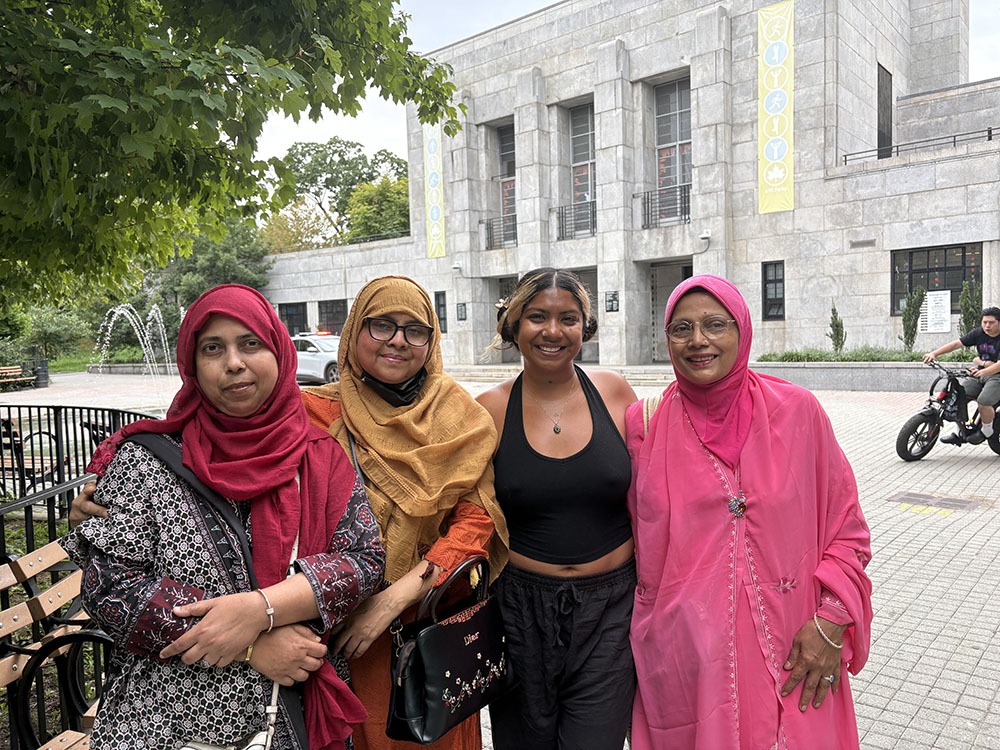
Khan announced that she will be stepping down from her role as executive director in December and that the organization will continue as a working cooperative. She said she has handpicked eight members to lead the organization, some of whom Norwood News also spoke to, i.e. Shamina Akhter, Seheli Akter, Nasima Alam, and Nargis Parvin and asked how Laal had impacted upon their lives.
For her part, Akter, who has three daughters aged 16, 10 and 5, said when she was at home before, there was a lot of stress, worry and tension. “When she comes to Laal, she’s able to let that go and forget about it and be present,” Khan said, translating from Bengali.
“Sanjana helped me mentally,” Akter said. “She came to my home and talked.” We asked if there was youth programming for kids. Khan said there was not. “But if we do any of the programs, like events, picnics, mela [fair], bazaars, anything, screenings, the kids are welcome.”
Akter said her oldest daughter is “super supportive” of her mom attending Laal. Khan previously told Norwood News how she and her colleague started the organization because they noticed how their own moms were sidelined within the community. Khan added that Akter is an excellent cook, caters for all their events, and is available to hire. She also said that since joining Laal, Akter’s husband has noticed that she is “in a better mood” and “everybody’s happy.” She added that Akter said she’s really excited to try more programs and lead the organization. “Like there’s an excitement. She’s trying her best and she’s very confident she’s gonna be able to do it,” Khana said.
Alam is 65 and looks amazing. Khan said as a result of joining Laal, “She can do yoga, and she can walk, and she can punch people [since she learned self-defense]! Alam added, “When I came here, I just give up my life. I don’t want a life because I don’t have anyone to talk to.” She said Laal gave her support. Khan said Alam’s husband is old and extremely sick and Alam is his carer and also takes care of her kids. She added that often it’s the norm in the Bengali / Islamic culture for there to be a 10 to 15-year age gap between husband and wife and that it is the wife’s responsibility to care for everyone.
“It’s like almost a systematic way, a cultural way of putting elder care on the women,” Khan continued. “So, you know, the woman lives longer. When the woman is old, who’s there to take care of her? It’s a vicious cycle.” Alam said she used to feel “too sad” and wanted to study and that she would go to the mosque on Fridays, and one time a woman suggested that she attend Laal.
“When I come, I saw to my angel Sanjana,” she said, adding that Khan asked for her phone number but her son said she shouldn’t give anyone her phone number and she cried and then Khan said it was ok, that she would give Alam her own number instead. “She have.. she love,” Alam said of Khan, adding that now, she organizes her dresses for social events and she feels young again and that Khan calls her sister (Apu), and not auntie, a common term of familiarity within the community but one which makes her feel older.
Alam said now her son and husband are supportive of her attending Laal. “You learn,” she said they said. “Now, I have something,” she said of her education. She added that she’s losing her memory but is trying. Khan said Alam is inspiring a lot of younger women given she’s become so active within Laal despite her age. “She takes care of all of the younger girls, so she’s become a mother role and I think it’s because she didn’t have a daughter,” Khan said. “I am feeling now too much happy,” Alam said. “Before I didn’t because I younger, I’m married. I didn’t go to school.”
Parvin immigrated to the U.S. in 2023, and in 2024, she was introduced to Laal through an existing member. Asked what was the biggest benefit she got from her membership, she said her willingness to live, and her confidence. “Her spirit has returned,” Khan said, translating. “She didn’t know anyone. She didn’t know the language. She didn’t have money. She was one year alone at home and wouldn’t leave until she met Nasima. She lives by herself with her two daughters, two kids, because her husband is not here. She now definitely feels like she’s not alone, but also this fact that if she’s in any trouble, she could either call me or any of the Laal ladies, and she knows it’ll be taken care of.”

Photo: Síle Moloney
Akhter, who is Laal’s office manager, said her three favorite programs are the mental health support group, ESL, and digital literacy. Interpreting, Khan said, “One thing she learned from Laal is [the benefit of] the yoga teacher. She was tight and now is flexible and has learned how to move her body. She was in a lot of pain before, and now has been able to like succumb [to] the pain. She wasn’t able to pray standing up. Now she can pray standing up.”
Khan added that the office manager job is Akhter’s first job. “This is the first time she’s ever been employed,” she said. “She believes that a woman’s independence is really important, especially financially, because she’s never had it before. We always depend on a husband. We have to ask him for everything. She used to feel really bad personally. She used to feel like [she] couldn’t be able to do it.” Khan said Akhter said she almost felt like she was abandoning herself. “Now, she can spend her money the way she wants. She can give money to her kids.”
Norwood News asked what she meant by abandoning herself. “When she didn’t have her own money, she felt like she was abandoning herself afterwards when she didn’t have dinner, and she was asking her husband for everything,” Khan said. She added that Akhter also said she was able to make a lot of friends and now knows pretty much everyone in the neighborhood because of Laal. Khan said she had been very shy.
“Shamina’s really been able to overcome that” Khan said. “She’s been to D.C. She did an overnight trip with us two times. She did a retreat with a Bronx organization and went on some retreat.” Khan added that she even went alone at times. Asked if Akhter’s husband was reticent at the beginning about her joining Laal, Khan said Akhter said her husband is now happy with the fact that she’s working. “Now he’s respecting her. He was not fearful before. He actually sent her, encouraged her to come and it’s just gone even better. He was like, ‘Money’s coming!'”
Asked how she felt about the idea of the collective leadership of Laal going forward, Khan said, “There is confidence. She’s afraid because she hasn’t done it before, and I have been around, but she is confident they will be able to do it.”
We asked Akhter for her thoughts on Khan. Embarrassed given she had to translate compliments about herself, Khan said Akhter said, “God wished this. That’s why she came. It was God’s plan. It was God’s plan.” Khan continued, “She said that before, it’s just so hard. Oh, it’s so sad. But like before, she’s saying that they were nothing, but that’s not true. She’s saying that now, the confidence.. She said that [Khan] really taught me how important it is to have an income.” She added that Akhter said of Khan, “Your love, your heart, and your guardian.”
For more information on Laal, visit https://www.laalnyc.org/.

admin
Welcome to the Norwood News, a bi-weekly community newspaper that primarily serves the northwest Bronx communities of Norwood, Bedford Park, Fordham and University Heights. Through our Breaking Bronx blog, we focus on news and information for those neighborhoods, but aim to cover as much Bronx-related news as possible. Founded in 1988 by Mosholu Preservation Corporation, a not-for-profit affiliate of Montefiore Medical Center, the Norwood News began as a monthly and grew to a bi-weekly in 1994. In September 2003 the paper expanded to cover University Heights and now covers all the neighborhoods of Community District 7. The Norwood News exists to foster communication among citizens and organizations and to be a tool for neighborhood development efforts. The Norwood News runs the Bronx Youth Journalism Heard, a journalism training program for Bronx high school students. As you navigate this website, please let us know if you discover any glitches or if you have any suggestions. We’d love to hear from you. You can send e-mails to norwoodnews@norwoodnews.org or call us anytime (718) 324-4998.