



Photo courtesy of Montefiore Einstein Comprehensive Cancer Center
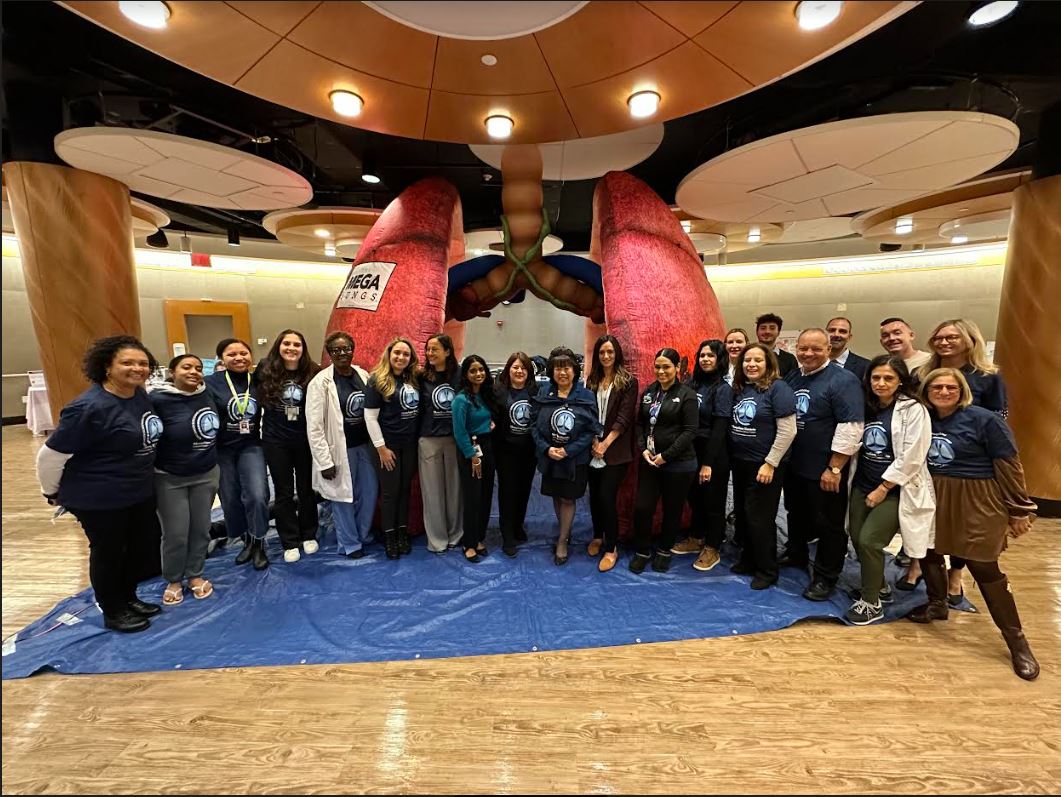
The five-year survival rate for Stage I or Stage II lung cancer is now more than 65%, compared to just 8% for later-Stages III and IV of the disease, according to the American Lung Association. The news was welcomed by Montefiore Einstein Comprehensive Cancer Center (MECCC) officials who said their clinicians are now finding cancers when they are most treatable and curable thanks to enhanced screening, novel care, access to clinical trials, and community education.
MECCC officials said that for several decades, The Bronx has experienced higher-than-average lung cancer mortality rates compared with other New York City boroughs, primarily due to Bronxites being diagnosed at later stages of the disease. They said today’s lifesaving “stage shift,” driven by what they described as “MECCC’s internationally acclaimed lung team,” is expected to drive up survival rates.
MECCC officials said early detection enables 95% of lung cancer operations at Montefiore Einstein to be performed with minimally invasive “lung sparing” techniques, and they added that this allows greater preservation of normal lung function so Bronx residents can return to enjoying full lives post-cancer treatment.
Brendon Stiles, M.D., professor and chief of thoracic surgery and surgical oncology, and cardiothoracic & vascular surgery at Montefiore and at Albert Einstein College of Medicine, said, “It is nothing short of remarkable to see our comprehensive cancer efforts completely change the trajectory of lung cancer care and survival over the last four years.”
Stiles, who is also associate director of surgical services at MECCC, added, “With our patient-first philosophy and comprehensive suite of programs like our incidental lung nodule clinic, we’re screening more people earlier and are enrolling approximately 20% of our patients with screen detected lung cancer into clinical trials to ensure Bronx residents benefit from tomorrow’s cancer therapies, today.”
Officials at MECCC went on to say that lung cancer is the second most common cancer and the leading cause of cancer death in the United States. They said a combination of factors contributes to lung cancer, including air pollution, exposure to radon (a natural, radioactive gas), tobacco use, secondhand smoke, and genetics. As reported, The Bronx also has one of the highest incidences of asthma, due in part to poor air quality in the borough.
To identify cancer at an earlier stage, MECCC officials said it ramped up the low dose, lung cancer screening program and introduced a Follow-Up “ASsessmenT” of Lung Nodules (FAST) clinic. They said the clinic leverages artificial intelligence and clinical education to guide patients with lung nodules unexpectedly found during X-rays or chest scans, unrelated to cancer care at Montefiore Einstein (like trauma, chest pain, or cardiac workups).
They said the MECCC team is also exploring blood-based assays to triage people who have the highest risk of cancer and to ensure expedited care. An assay is a laboratory test or procedure used to measure the presence, amount, or functional activity of a specific substance, such as a drug, a chemical, or a biological molecule.
Since its opening in 2021, MECCC officials said the FAST clinic has received more than 1,000 referrals, and of these referrals more than 80 patients have been diagnosed with lung cancer and cared for at MECCC.
They said these efforts are supported by a “robust clinical trial program exploring the use of precision medicine and targeted therapies for individuals with high-risk, early-stage lung cancer to those with more advanced disease.”
MECCC officials said a key contributor to its success in reversing the severity of lung disease in The Bronx is that its patients are at the center of every effort. Drawing from the principles of community-based participatory research, they said MECCC’s lung team co-created educational materials in partnership with its Bronx community that were relevant and language appropriate.
They said this content is coupled with trained nurse and peer navigators to address social hardships that are often overlooked in daily practice. They cited lack of transportation as one example.

Photo courtesy of the Office of Congressman Ritchie Torres
MECCC officials went on to say the achievement in reversing late-stage lung cancer diagnoses follows MECCC’s lung cancer team recognition this past September, as reported, by the International Association for the Study of Lung Cancer for delivering outstanding cancer care. They said this team, nominated by patients, family members and caregivers, was the only award recipient in North America.
Paulie Ammirato, a Bronx resident and former engineering director at Montefiore, who had stage IA lung cancer said, “When an irregularity was found on my CT scan, Dr. Stiles quickly arranged for my surgery.”
She continued, “Everything went as planned and I recovered earlier than expected. Any spot on a lung must be looked at as soon as possible. Don’t delay care. With the quick treatment and support of Dr. Stiles and his excellent team, I’m healthy and back to my active lifestyle. There’s nothing more important than your health and I’m forever thankful for this team and the excellent nursing care at Montefiore for their follow through. They were my guardian angels.”
Meanwhile, on Tuesday, Nov. 25, Congressman Ritchie Torres (NY-15) held a press conference with Weill Cornell Medicine in The Bronx to spotlight National Lung Cancer Awareness Month, and the launch of a new mobile lung cancer screening unit.
At the event, Torres also announced the introduction of the Lung Cancer Screening Expansion Act of 2025, a new bill that would require full insurance coverage for annual lung cancer screenings for adults 50 to 80 who are at increased risk.
Torres said The Bronx has the highest rate of advanced lung cancer at diagnosis in New York City. He said the mobile screening unit will bring low-dose CT scans, care navigation, and smoking cessation support directly into neighborhoods that have long faced barriers to early detection.
“In The Bronx, people are dying because they’re being diagnosed with lung cancer far too late,” said Torres. “That isn’t acceptable. This mobile unit brings lifesaving screenings right to our streets, and my bill will make sure cost and paperwork can’t stand in the way. Early detection saves lives, and the Bronx deserves the same fighting chance as every other community.”
The bill requires private insurers and all major federal health programs to cover annual low-dose CT screenings with no out-of-pocket costs and bars prior authorization, step-therapy rules, or other hurdles that often delay care.
Founded in 1971 and an NCI-designated cancer center since 1972, MECCC’s mission is to reduce the burden of cancer for all, especially people from historically underrepresented groups.

admin
Welcome to the Norwood News, a bi-weekly community newspaper that primarily serves the northwest Bronx communities of Norwood, Bedford Park, Fordham and University Heights. Through our Breaking Bronx blog, we focus on news and information for those neighborhoods, but aim to cover as much Bronx-related news as possible. Founded in 1988 by Mosholu Preservation Corporation, a not-for-profit affiliate of Montefiore Medical Center, the Norwood News began as a monthly and grew to a bi-weekly in 1994. In September 2003 the paper expanded to cover University Heights and now covers all the neighborhoods of Community District 7. The Norwood News exists to foster communication among citizens and organizations and to be a tool for neighborhood development efforts. The Norwood News runs the Bronx Youth Journalism Heard, a journalism training program for Bronx high school students. As you navigate this website, please let us know if you discover any glitches or if you have any suggestions. We’d love to hear from you. You can send e-mails to norwoodnews@norwoodnews.org or call us anytime (718) 324-4998.