


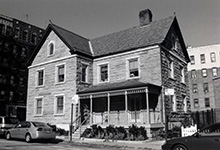

Health leaders and members of the Bronx’s Southeast Asian community gathered at the Bronx Library Center on Kingsbridge Road on Sept. 18 to discuss the health issues affecting the borough’s Vietnamese and Cambodian populations.
The “Health Justice Forum” was organized by the Youth Leadership Project (YLP), a project of CAAAV: Organizing Asian Communities, a Valentine Avenue based non-profit.
The three-hour event sought to bring attention to the community’s poor health, and the need for translation services, culturally competent staff, and herbal remedies at Montefiore Medical Center.
According to the 2005 American Community Survey, approximately 1,000 Cambodians live in the Bronx, mainly in the Fordham Road area. Most came to the United States in the late 1970s to escape the brutal Khmer Rouge regime. The Bronx’s Vietnamese community – which numbers more than 3,000, according to Census figures – arrived in the country after the fall of Saigon in 1975. They, too, chose Fordham as their new home.
For these war-torn refugees, experiences of torture, oppression, and starvation have led to mental health disorders, such as depression and anxiety. They also experience high rates of diabetes and heart disease.
For the past year, YLP has been meeting with Montefiore staff to talk about the community’s needs, as well as resources and funding. But the relationship between the hospital and borough’s Southeast Asian population goes back decades.
In the early 1980s, Montefiore established the Indochinese Mental Health Clinic, to provide services to the newly arrived refugees. The clinic, staffed by a social worker and part-time psychiatrist, still exists at the Montefiore Family Health Center on East 193rd Street, but Montefiore reassigned its two full-time Vietnamese and Khmer translators in 1998, citing financial constraints. Instead they rely on bilingual staff members who do not receive additional pay to translate, and who are not technically required to do so under their employment contracts.
Back in 1998, CAAAV and several Montefiore employees protested Montefiore’s decision, instigating a federal civil rights investigation. While the full-time translators were never reinstated, CAAAV kept the issue alive.
“The problem as we see it is that Montefiore is not hurting for funds and has not invested anything beyond words thus far,” says Shaun Lin of the YLP. “It would not require much on their behalf — a small investment in a full-time translator or training program for the current staff at the clinic — to get the ball rolling.”
At the health forum, Dr. Zach Rosen, the Medical Director of the Montefiore Family Health Center, said that providing full-time translation is a complicated matter. In a telephone interview he said, “I would love to see an expansion of services,” but adds that effective, full-time translators require extensive training in medical language and equipment. Rosen says Montefiore has held meetings with CAAAV for the past year and is “trying to find funding sources.”
Touch Si came from Cambodia in the mid-’80s after losing contact with her 15 brothers and sisters. “I don’t go to appointments because there are no translators,” she said through a CAAAV translator.
Montefiore requires doctors to call an information line operated by Pacific Interpreters when they need help with translations during an appointment. But Si says of phone translators, “You can’t show what is happening to you or where you feel pain.”
Patients often use their children to interpret during hospital appointments, said those at the forum, which can cause problems. YLP Youth Organizer Jimmy Le relates how, as a young child, he mistranslated and told doctors that his mother was “mentally insane.” She was actually experiencing chronic headaches and “mental pain.”
Though it is not written policy, Rosen says that child translators are frowned upon and considered unethical, especially for relaying potentially traumatic medical information.
But even when English is understood, cultural barriers persist.
Heang Tan, of Khmer Health Advocates, a Connecticut-based group, shared a story that recently appeared in the Boston Globe. Cambodian immigrant Heap You told doctors she feared her neck would explode. Thinking she was mentally ill, they put her on anti-psychotics, and referred her to psychiatrist, who discovered that You, like many Cambodians, believed poor circulation of wind inside the body could trigger explosions of air through the neck.
Cambodians treat this problem with “cupping,” placing heated glass cups on the skin to “suck out” excess air. To reassure You, the psychiatrist told her that her neck would not explode and encouraged her to undergo cupping. His cultural sensitivity helped gain You’s trust, and he was able to correctly diagnose her problem. He removed her from the anti-psychotics and prescribed medication to address her insomnia and anxiety.
Tan says that doctors must understand both a patient’s medical history and their cultural history.
Rosen agrees. “Rather than have a patient be ashamed of their traditional medicine techniques, like cupping, they could see it actually offered at the hospital.” He says that culturally sensitive medicine has already been incorporated at Lowell General Hospital in Massachusetts and he’s hoping Montefiore will follow suit.
Lin, of the YLP, said his group is anxious to see action. “Despite Montefiore’s openness to having these conversations, there seems to be a lot of resistance [to change],” he said.
Ed. note: The Norwood News is published by Mosholu Preservation Corporation, a not-for-profit affiliate of Montefiore Medical Center.

admin
Welcome to the Norwood News, a bi-weekly community newspaper that primarily serves the northwest Bronx communities of Norwood, Bedford Park, Fordham and University Heights. Through our Breaking Bronx blog, we focus on news and information for those neighborhoods, but aim to cover as much Bronx-related news as possible. Founded in 1988 by Mosholu Preservation Corporation, a not-for-profit affiliate of Montefiore Medical Center, the Norwood News began as a monthly and grew to a bi-weekly in 1994. In September 2003 the paper expanded to cover University Heights and now covers all the neighborhoods of Community District 7. The Norwood News exists to foster communication among citizens and organizations and to be a tool for neighborhood development efforts. The Norwood News runs the Bronx Youth Journalism Heard, a journalism training program for Bronx high school students. As you navigate this website, please let us know if you discover any glitches or if you have any suggestions. We’d love to hear from you. You can send e-mails to norwoodnews@norwoodnews.org or call us anytime (718) 324-4998.