


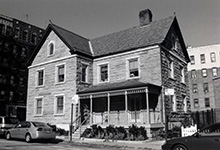

Gloria Thomas remembers when her building at 2505 Aqueduct Ave., where she’s lived for nearly 30 years, was the envy of neighbors nearby.
“When I moved in this building, in the lobby was a huge mirror over this beautiful fireplace, and wrought iron benches,” she remembered.
Now, the mirror has been broken for years and the benches are long gone. The halls are dirty, her ceiling leaks and her bathroom sink has been clogged for weeks, Thomas says.
Her building is one of more than a dozen Bronx properties, at least two of which are located in University Heights, owned by Milbank Real Estate, a private equity firm based in Los Angeles. The company bought the buildings in 2006 and 2007, taking out massively expensive mortgages to do so. When rents were not profitable enough to cover mortgage payments, Milbank defaulted on the loan, sending the properties into foreclosure proceedings.
Since then, tenants at Milbank’s apartments have seen the condition of their homes deteriorate rapidly. Reports of rodents, mold infestations and weeks without hot water are par for the course. Some of the buildings have hundreds of housing code violations.
“When Milbank took over, things got worse,” said Etta Hill-Banks, who has lived at 2505 Aqueduct Ave. since 1978.
Complicated and risky mortgages, lent by banks during the boom times, have put many New York buildings into similar predicaments. Tenants, in the meantime, are caught in a strange limbo where it’s unclear who should be held responsible for the upkeep of the buildings.
“[The lack of accountability] was part of the problem with these mortgages,” said Gregory Lobo Jost, deputy director for the nonprofit University Neighborhood Housing Program.
Mortgages, like the ones Milbank took out, often get packaged with others, forming a huge, multi-billion dollar trust (known as a mortgage backed security) that’s then sold off in pieces to a number of investors.
Technically, it’s this group of faceless investors that owns these mortgages, and the entire trust is controlled and overseen by a bank, Jost explained.
“In this whole process, who has any responsibility?” he asked.
It is the banks, says one legal group. Legal Services-NYC Bronx recently filed a legal motion on behalf of the tenants in 10 of Milbank’s properties, attempting to hold Wells Fargo, the bank that oversees the huge trust that contains the mortgages (or the trust’s special servicer, a company called LNR Property Group) financially responsible for the maintenance of the buildings.
“This deal is structured so that everybody can evade liability,” said James Jantarasami, a staff attorney with Legal Services-NYC. “Somebody has to be held accountable.”
Milbank’s mortgage on these properties is indicative of many deals that were made during the housing boom that imploded two years ago, Jantarasami said. Real estate firms took out expensive mortgages and bought up properties in low-income neighborhoods, with the hopes of cleaning up the buildings, forcing current tenants out and hiking rent prices to new tenants.
Milbank did not return calls for comment by press time. But their website, which still lists the Bronx properties as part of their portfolio, lays out some of their business plan.
“Milbank identified the Bronx borough of New York as one of the last boroughs to offer affordable rent, which would also be positioned to undergo significant gentrification,” it reads.
But that gentrification never came, according to Jantarasami, or at least not at the rate Milbank anticipated. And without the base of wealthier tenants they’d hoped for, the group could no longer afford to maintain the buildings and make their mortgage payments.
Once the building went into foreclosure, the trust’s special servicer, LNR, was in charge of handling the proceedings. At the same time, the court appoints a receiver, someone in charge of upkeep and collecting rents.
But by this time, some of the buildings are in such a state of disrepair that rents don’t cover the costs for the receiver to do necessary maintenance, as with many of Milbank’s properties.
“We inherited a building that is in distress and has been neglected,” said Walter Rivera, a Bronx attorney who was appointed as receiver for two of Milbank’s properties on Garden Street (these two buildings—770 and 780 Garden St., are not one of the 10 properties involved in Legal Service-NYC’s current motion, as they were packaged in a different trust).
Rivera says he’s aware of the building’s problems, but doesn’t have the funds to fix them.
The legal motion is attempting to force Wells Fargo or LNR to provide the money to receivers like Rivera, so they can afford to keep the buildings livable, said Jantarasami.
Wells Fargo denied any responsibility. In an e-mail response, a spokesperson said the bank does not own or control the loans on the Milbank properties, but merely serves as the trustee for COMM 2006-C8, the huge mortgage backed security that these 10 buildings are a part of.
“The role of the Trustee is to represent the interests of the certificate holders, who are the owners of these loans, and to perform administrative duties for the Trust,” said spokeswoman Elise Wilkinson in e-mail.
“The Special Servicer (LNR Partners) makes decisions about the status of the loans and/or properties and the court-appointed Receiver is responsible for day-to-day maintenance,” Wilkinson said. “All questions related to the upkeep of the properties should be addressed to those parties.”
LNR declined to comment on the case.
A hearing is scheduled for the legal motion for June 12, Jantarasami said, unless there’s a settlement. If the action is successful, it could set a precedent for other buildings that suffered a similar fate.
For Milbank’s tenants, any solution would be relief.
“I hope that the city itself will step in and see that the repairs are done,” Hill-Banks said.

admin
Welcome to the Norwood News, a bi-weekly community newspaper that primarily serves the northwest Bronx communities of Norwood, Bedford Park, Fordham and University Heights. Through our Breaking Bronx blog, we focus on news and information for those neighborhoods, but aim to cover as much Bronx-related news as possible. Founded in 1988 by Mosholu Preservation Corporation, a not-for-profit affiliate of Montefiore Medical Center, the Norwood News began as a monthly and grew to a bi-weekly in 1994. In September 2003 the paper expanded to cover University Heights and now covers all the neighborhoods of Community District 7. The Norwood News exists to foster communication among citizens and organizations and to be a tool for neighborhood development efforts. The Norwood News runs the Bronx Youth Journalism Heard, a journalism training program for Bronx high school students. As you navigate this website, please let us know if you discover any glitches or if you have any suggestions. We’d love to hear from you. You can send e-mails to norwoodnews@norwoodnews.org or call us anytime (718) 324-4998.