


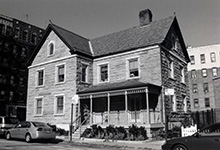


Photo courtesy of Bronx Community College
The Restorative Wellness Playground is a program with a mission to develop deeper, personal, physical and mental health throughout Bronx Community College (BCC) and its extended community by learning to authentically practice self-care. This includes expressing an individual’s own voice, exercising one’s choices, and the personal narrative of joyously telling one’s own story.
Professor Kelvin Cooper, chair of the BCC’s Department of Health, Physical Education and Recreation, established the program embodying the mission of restorative justice to increase the health and personal authenticity of people at all levels of BCC and its environment.
The program is partly based on the work of Brazilian philosopher and educator, Paulo Freire. Freire, a Portuguese philosopher and educator, in the early 1900s was a prominent proponent of critical pedagogy, which encourages learners to question inequities and oppression in society.
His work, as quoted by Cooper, holds that “all discrimination is immoral and to struggle against it is a duty.” The element of non-discrimination points towards betterment of health and life for individuals, as well as justice for classes of people who are discriminated against.
Cooper’s emphasis on restorative justice emanates from a healing perspective, first acknowledging that a problem exists, specifically the fact of injustices in society, and the need for people to learn how to effectively express themselves as well as to improve their health, and to restore the health they may have had, or never had. These two elements are related to one another.
Restorative justice is uniquely helpful in addressing the need to correct and heal discrimination, moving forward toward the goal of true justice. Alongside the path towards justice are the practices leading to the best possible physical and mental health outcomes, all reaching together for human liberty. The integration of these elements is experienced in the varied topics and activities offered in the restorative wellness practical workshops.
There is a need for personal and societal exploration of the concept of restorative justice. Paula Braverman and colleagues wrote in “Health Affairs” in 2022 that “systemic racism is so embedded in systems that it is often assumed to reflect the natural, inevitable order of things.” As a commentary, Cooper notices that we take on the authoritative beliefs of the surroundings.
To go beyond the established system, the basis of restorative justice emanates from the need for both improved health (including finding out who you are, and seeing others as who they are, as their real, unmasked identities) as well as acknowledging increased opportunities for true justice, particularly through education. Cooper’s project connects those thoughts.
The program offers workshops to teach participants how to learn more about improving their own health, by taking command of their physical and mental health practices. The notion of “playground” establishes community, connectedness and synergy. According to Cooper, the mental and physical health activities establish a safe and inclusive environment designed to break down barriers of fear, isolation and confusion.
These feelings and others, as explored from a personal perspective, help participants to learn how to think deeply and to effectively find ways to express themselves, to know what they want to say, and to say it, to speak freely. Some of what is said is in the realm of standing for justice.
The activities in some of the discussions and workshops that Cooper created include “games for releasing oxytocin and endorphins: activities for building interpersonal skills; meditation practices for regulating the nervous system, including grounding; body movement for physical fitness, particularly postural alignment, muscular flexibility and cardiovascular endurance; cultural dance experiences and stress management strategies.”
The games and activities can be adapted to different populations and age groups. Professor Cooper has carved out a worthy task, a unique, practical and specific linkage between health and justice.
His success in reaching the minds of people is demonstrated by the popular workshops he has created to offer opportunities to integrate and pursue the mental concepts of justice and health.
Dr. Joyce L. Bloom is an adjunct professor at Bronx Community College

admin
Welcome to the Norwood News, a bi-weekly community newspaper that primarily serves the northwest Bronx communities of Norwood, Bedford Park, Fordham and University Heights. Through our Breaking Bronx blog, we focus on news and information for those neighborhoods, but aim to cover as much Bronx-related news as possible. Founded in 1988 by Mosholu Preservation Corporation, a not-for-profit affiliate of Montefiore Medical Center, the Norwood News began as a monthly and grew to a bi-weekly in 1994. In September 2003 the paper expanded to cover University Heights and now covers all the neighborhoods of Community District 7. The Norwood News exists to foster communication among citizens and organizations and to be a tool for neighborhood development efforts. The Norwood News runs the Bronx Youth Journalism Heard, a journalism training program for Bronx high school students. As you navigate this website, please let us know if you discover any glitches or if you have any suggestions. We’d love to hear from you. You can send e-mails to norwoodnews@norwoodnews.org or call us anytime (718) 324-4998.