


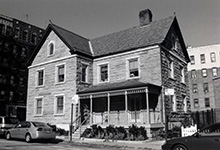

During the Community Board 7 meeting last week at the Bedford Park Senior Center, Chairman Greg Faulkner took a moment, during a break in the action, to admonish the handful or so missing Board members who had neglected to call and excuse their absences.
“Only one board member called to say they weren’t coming,” Faulkner said, adding that three unexcused absences by a member would result in a penalty where the offender would be brought in to explain themselves to the rest of the Board.
As Faulkner said when his slate of officer candidates won a resounding victory in Board elections earlier this summer, “This is a new day at Community Board 7.”
Indeed. And in addition to enforcing an attendance policy, Faulkner introduced changes to the bylaws that would reconfigure the committees and impose term limits for committee chairs. The changes will be voted on by the Board in October. Faulkner said the proposed changes are all part of a plan to make the Board more productive, active and vocal. “We’re trying to refocus the resources of the Board and enhance its role in the community,” he said.
For example, Faulkner said, overwhelmingly, the greatest number of calls the Board receives are quality of life concerns like excessive noise or graffiti. In response to that, Faulkner is proposing the Board combine “Quality of Life” with “Public Safety” into one committee and make “Traffic and Transportation” its own committee. (See sidebar for complete list of proposed committees.)
A representative from the Bronx borough president’s office said it’s not unusual for a chairman of a Board, especially a new one, to rearrange the committees or change the bylaws to better fit the needs of the district.
To go along with the revamped committees, Faulkner and first vice chairman Paul Foster want committee heads to be more active and held more accountable, which is why they want to impose one-year term limits. Last year, some committees never even met, Faulkner said.
“All of us need to respond to the community and if we’re not producing then we need to be held to a high standard,” Faulkner said.
Foster added another reason for enforcing higher standards. “We are not going to be here forever,” Foster said. “So it’s important for us to develop new leadership.”

admin
Welcome to the Norwood News, a bi-weekly community newspaper that primarily serves the northwest Bronx communities of Norwood, Bedford Park, Fordham and University Heights. Through our Breaking Bronx blog, we focus on news and information for those neighborhoods, but aim to cover as much Bronx-related news as possible. Founded in 1988 by Mosholu Preservation Corporation, a not-for-profit affiliate of Montefiore Medical Center, the Norwood News began as a monthly and grew to a bi-weekly in 1994. In September 2003 the paper expanded to cover University Heights and now covers all the neighborhoods of Community District 7. The Norwood News exists to foster communication among citizens and organizations and to be a tool for neighborhood development efforts. The Norwood News runs the Bronx Youth Journalism Heard, a journalism training program for Bronx high school students. As you navigate this website, please let us know if you discover any glitches or if you have any suggestions. We’d love to hear from you. You can send e-mails to norwoodnews@norwoodnews.org or call us anytime (718) 324-4998.