



Janice, 57, discovered she was HIV-positive in 1991. “It was a big shock,” said the Fordham resident, a quiet-spoken woman with a kind smile, who asked that her last name not be used. “At that time you were handed a death sentence.”
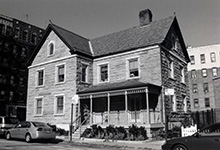
But thanks to advances in medicine, people with HIV/AIDS are living longer, and through organizations such as Bronx AIDS Services (BAS), which celebrated its 20th anniversary this summer, those with the disease have access to a multitude of free services.
Bronx AIDS Services started with limited resources and just 15 employees. Over time, however, as the AIDS epidemic continued to rage, government funding for AIDS programs crept up. Today BAS, which is headquartered on Fordham Road, has an annual budget of $8 million and 100 full-time employees.
“They [BAS] really really came through for me,” said Janice, one of 22,000 known Bronx residents with HIV/AIDS. “They helped me with housing problems, and they helped me with food.”
 As well as providing a food service, and free legal aid to help with housing issues and custodial battles, BAS helps its clients access benefits, healthcare, mental health counseling and substance abuse programs.
“We are in some ways an anti-poverty agency for people who live with AIDS,” said SJ Avery, BAS’ chief executive officer, who has led BAS for the past 14 years. “The impact of AIDS is doubly harsh on poor people. We can’t expect people to take their medicine or be connected to a physician if they don’t have stable housing.”
At the same time, said Avery, prevention is increasingly an important part of their work. Through a walk-in service and two mobile testing units, BAS conducts thousands of HIV tests each year. They offer counseling and connections to medical care for those who test positive, and advice on avoiding infection to those who don’t.
Through outreach initiatives, BAS seeks to test and educate vulnerable groups of people, and they run several unique programs, including GO GIRL!, which provides HIV and domestic violence prevention services to girls in the juvenile justice system, and HOLA, a support group created for and by gay Hispanic men.
Rafael Lopez, a Norwood resident and HOLA’s general coordinator, was diagnosed with HIV in 2003. Lopez says he feels healthy, but his medication – five tablets a day – is a constant reminder of his disease.
Like Janice, Lopez has kind words for BAS. “Thanks to them, I was able to be certified as an HIV counselor and I’ve become much more active in the HIV community,” he said. “I’ve grown as a human being, and as a Hispanic gay man.”
In 1981, when HIV/AIDS was first identified, it was dubbed GRID, or Gay-Related Immune Deficiency. Only later did health officals, realizing that the disease didn’t only affect gay men, change the name to AIDS, or Acquired Immune Deficiency Syndrome.
Around 900 cases of HIV/AIDS are diagnosed in the Bronx each year – which as a percentage of the population, is more than any other borough. The majority of BAS’ clients cite drug use, specifically sharing needles, as the “at-risk behavior” that led to them contracting the disease.
For Avery and Jose Davila, BAS’ executive director, one of the keys to keeping these numbers in check is fighting the stigmatization associated with HIV/AIDS. Stigma breeds ignorance, they said, and discourages people from getting tested and seeking help.
“When we [Avery and Davila] were first in the field in the 1980s, hospital workers would leave trays of food outside rooms and some physicians were refusing to treat people with AIDS,” Avery said.
“Today, you don’t see some of the wicked ostracizing you used to see,” she continued. “But is stigma still there? Sure.” Avery gave a recent example: At BAS’ 20th anniversary bash, a waitress asked what BAS stood for. When Avery explained, the waitress’ first reaction was to utter “Ooh,” and make a face.
Stigma can also manifest itself in bullying. Earlier this year, teenager Raven Lopez (no relation to Rafael) was harassed by classmates at her Fordham school for being HIV positive. Lopez, whose mom, Michelle, is a BAS board member, was forced to move schools. (In the fall, BAS is hoping to visit local schools to educate students on the disease.)
If fighting stigma is one of BAS’ primary challenges, obtaining funding is another. At a federal level – and over 50 percent of BAS’ funding comes from federal grants – an increasing chunk of the available money is being set aside for “abstinence-only” programs. While BAS does talk about abstinence, Avery said, they don’t apply for funding that would prevent them from talking about condom use.
“The great irony is that they’ve [abstinence-only programs] not been proven to be effective,” Avery said. “They make people of a certain religious persuasion feel good, but there’s not demonstration they’re effective.”
Davila, who’s taking the helm at BAS when Avery retires in December, is also concerned about the “medicalization” of AIDS services, which is funneling money away from social service organizations like BAS and into clinics and hospitals. He thinks this is a mistake. “A lot of people won’t go to a clinic,” he said. “You want to meet people where they are.”
To make BAS more independent, Davila is eager to increase the organization’s fund-raising abilities and set up a for-profit section of BAS, to support programs that are strapped for cash.
As Davila looks forward, Avery, on the eve of her retirement, looks back. “People died right and left when I was first in this field,” she said. “There is still no cure, no vaccine … but to see people live longer is probably the most striking of the changes.”
Janice is one of these people. She watched her husband die of AIDS but, 15 years after her own diagnosis, Janice is still very much alive, and able to enjoy time with her “beautiful granddaughter.”
Ed. note: For more information about Bronx AIDS Services visit http://www.basnyc.org or call (718) 295-5605.

admin
Welcome to the Norwood News, a bi-weekly community newspaper that primarily serves the northwest Bronx communities of Norwood, Bedford Park, Fordham and University Heights. Through our Breaking Bronx blog, we focus on news and information for those neighborhoods, but aim to cover as much Bronx-related news as possible. Founded in 1988 by Mosholu Preservation Corporation, a not-for-profit affiliate of Montefiore Medical Center, the Norwood News began as a monthly and grew to a bi-weekly in 1994. In September 2003 the paper expanded to cover University Heights and now covers all the neighborhoods of Community District 7. The Norwood News exists to foster communication among citizens and organizations and to be a tool for neighborhood development efforts. The Norwood News runs the Bronx Youth Journalism Heard, a journalism training program for Bronx high school students. As you navigate this website, please let us know if you discover any glitches or if you have any suggestions. We’d love to hear from you. You can send e-mails to norwoodnews@norwoodnews.org or call us anytime (718) 324-4998.