


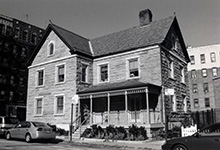

On a cloudy and chilly day in North Fordham, the women sitting in a classroom at Refuge House got a glimpse of sunshine.
Grace Institute, a nonprofit organization that provides free job training and employment assistance to underserved women in New York City, converted a classroom at Refuge House, on Bainbridge Avenue and East 196th Street, into a recruitment center for its upcoming daytime training program.
The institute usually holds information sessions at its headquarters in Manhattan, but, for the first time in its long history, the organization is conducting face-to-face outreach in the Bronx.
“The challenge is getting the word out,” said Mary Mulvihill, Grace Institute’s executive director. “Because we offer a tuition-free program, we don’t have enough money [for high-cost advertising]. So that’s our biggest challenge.”
On the first day of outreach, Bedford Park resident, Mary Arreaga, 41, showed up with her 11-year-old son, Edison, and her 19-year-old niece. Arreaga, who has a college degree in education from her native Ecuador, previously worked as a teacher, but has been unable to find work since she came to the United States in 2003.
“I was always asking about jobs,” she said. “I’ve applied in the past and didn’t find anything. I thought I could be a teacher here, but the doors are not so easily opened,” she said. “It is a great lie that life is easy in this country.”
Recently, Arreaga’s brother showed her a newspaper ad for Grace Institute’s Bronx information session. “It said that after the training, I would get a diploma from this country,” she said. “That’s what caught my attention.”
For over 100 years, Grace Institute has provided women like Arreaga with job training skills and helped them find gainful employment. Founded in 1897 by William Russell Grace, twice mayor of New York City, the organization began by teaching Irish immigrant women domestic and secretarial skills.
Currently, the Institute trains women in computer software, office procedures, business writing and math. Graduates of Grace are often able to leave minimum wage jobs, or leave the unemployment ranks, for positions that pay, on average, $32,000 per year plus benefits, Mulvihill said.
“Not only do women learn job skills, they learn community building,” Mulvihill said. “The women create their own communities with each other. They create the sense of family.”
Michele McEvoy, the institute’s admissions manager, said the family atmosphere is what makes the program work. “The women support each other and if someone doesn’t make class, they call each other and ask, ‘Where are you? Why aren’t you here?’” she said.
Despite the economic recession, 62 percent of the institute’s June graduates have found jobs. Though job opportunities remain scarce, there are encouraging signs. Sloan-Kettering Cancer Center, which often hires people Grace refers, recently announced it was expanding employment opportunities as they open a new facility.
Irlem Adames, a 2004 graduate, remembers how it felt to enter the program. “I was nervous, but I knew something positive was going to come out [of the program],” she said. Adames now works at Grace Institute. “It was definitely a turning point in my life,” she said.
The program, which is a full-time four-month-long commitment, may also prove to be the turning point that Arreaga is looking for. “People think that I might be lazy because I’m older,” she said. “But I can do the work, if someone gives me the opportunity.”
Ed. note: Grace Institute is holding information sessions through January, on Tuesdays, Wednesdays, and Thursdays, from 11a.m. to 2 p.m., at Refuge House, 2715 Bainbridge Ave., 2nd floor. For more information, call (212) 500-5953.

admin
Welcome to the Norwood News, a bi-weekly community newspaper that primarily serves the northwest Bronx communities of Norwood, Bedford Park, Fordham and University Heights. Through our Breaking Bronx blog, we focus on news and information for those neighborhoods, but aim to cover as much Bronx-related news as possible. Founded in 1988 by Mosholu Preservation Corporation, a not-for-profit affiliate of Montefiore Medical Center, the Norwood News began as a monthly and grew to a bi-weekly in 1994. In September 2003 the paper expanded to cover University Heights and now covers all the neighborhoods of Community District 7. The Norwood News exists to foster communication among citizens and organizations and to be a tool for neighborhood development efforts. The Norwood News runs the Bronx Youth Journalism Heard, a journalism training program for Bronx high school students. As you navigate this website, please let us know if you discover any glitches or if you have any suggestions. We’d love to hear from you. You can send e-mails to norwoodnews@norwoodnews.org or call us anytime (718) 324-4998.