


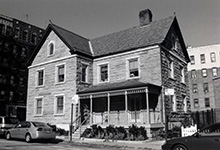

Sirio Guerino, a Norwood resident and activist who is well known locally for his graffiti obsession, is mad. This time they’ve gone too far, he says, shaking his head in disbelief as he looks at the faded remnants of a graffiti "tag" on the corner of St. Brendan’s Church.
Graffiti ranks at or near the top of most city communities’ lists of quality of life concerns. Its competitors include noise and dog poop and its presence is a telltale sign of urban blight, say police, city officials and anti-graffiti activists like Guerino.
So far in 2007, according to police statistics in the 52nd Precinct, graffiti complaints are up 45 percent and arrests are up 31 percent. That doesn’t necessarily mean there’s more graffiti, says Lieutenant Steve Phalen, the special operations officer for the 52nd Precinct, but it does mean people are being more vocal about their disdain for it.
Go to any community meeting in Community District 7 and someone will invariably talk about how their building or neighborhood park has become the latest target of taggers and graffiti offenders.
In response, this summer local politicians Council Member Oliver Koppell and Assemblywoman Naomi Rivera contributed tens of thousands of dollars to anti-graffiti initiatives.
The trick, Guerino, Phalen and others say, is to vigorously combat graffiti at every turn and let offenders know their efforts will be either punished or vanquished. While eliminating it may be impossible, constant vigilance can keep it from intruding too much into people’s lives.
That’s easier said than done, says Guerino, who helped to start an anti-graffiti group called Norwood Against Graffiti (NAG) in the 90s. Nowadays, he says, graffiti writers are more brazen and disrespectful, if not more prolific.
"They’ll tag on anything, cars, churches, private homes, anywhere there’s a wall," Guerino says, while walking down a particularly graffiti-heavy stretch of Webster Avenue. "You can’t walk down a street without seeing it."
Graffiti Was Everywhere
Back in the 1970s and 1980s, graffiti was everywhere and even became celebrated as an art form, Guerino says. But now, it’s more about being rebellious or marking your territory, he says.
Sometimes, the tags are gang-related, Phalen says, which is disconcerting, but it often helps police know which gangs are operating in which areas.
While tags are not usually attached to traditional gangs like the Bloods or Crips, its presence can escalate neighborhood rivalries. For example, local residents say that M-Mob, a loosely organized crew from Knox-Gates, exacerbated tensions with youth from across Mosholu Parkway in Tracey Towers, a Mitchell-Llama development, by tagging on their building. Residents believe the act may have contributed to a May shooting incident that left four young men from Tracey wounded.
Phalen says the best thing residents can do to combat graffiti is by calling 311 or the precinct itself (718-220-5811). This way, they can take steps to clean the graffiti and also identify places where they can send the precinct’s new Quality of Life unit and set up sting operations, like they’ve done at Target and Fordham Road.
Daniel Bernstein, the director of the Fordham Road Business Improvement District (BID), says his group has stepped up its anti-graffiti efforts since the beginning of the year. In fact, local business improvement districts have made the biggest dent in the graffiti scourge.
"It’s now part of the overall sanitation mission," Bernstein says. "We figured out that graffiti should be a big part of what we do."
Once a month, Bernstein walks the BID in search of graffiti hotspots. He then forwards his findings to the BID’s sanitation contractor, Atlantic Maintenance, which provides anti-graffiti services for some 30 of the city’s 50 BIDs. They’ll either paint or steam away the graffiti once a month.
The Jerome-Gun Hill BID (which honored Guerino for his work at the BID’s street festival last month), has been employing anti-graffiti services for at least a decade, working with a group called Partners in Grime, which gets rid of graffiti on storefronts almost immediately after it appears.
Roberto Garcia, executive director of the Jerome-Gun Hill BID, is now working to coordinate the efforts of Koppell and Rivera’s initiatives – both run through a group called City Solve – as their districts overlap. Currently, Koppell’s office is taking graffiti complaints and forwarding them off to City Solve, which then comes by every couple of weeks. Calls to Rivera’s office requesting more information on how she implements her program were not returned.
Graffiti And Shopping
Graffiti can be the difference between shoppers coming to the neighborhood or taking their money upstate to Yonkers, where graffiti isn’t as much of a problem, Garcia said.
While businesses and parks are often serviced by anti-graffiti measures, private residents are often left to fend for themselves, says Bedford Park resident John Reilly, a longtime housing advocate and head of the Fordham Bedford Housing Corporation.
His group has power washers and a paint supply to battle graffiti on buildings it owns. But in his neighborhood, where "there’s a lot of it," owners are "mostly cleaning it up themselves. There isn’t really much of a city response."
Reilly and Guerino both say it’s up to building owners to stay on top of graffiti on their apartment buildings.
Guerino’s group once received grants from the borough president’s office that allowed it to pay Partners in Grime to remove graffiti on Bainbridge Avenue and 204th Street weekly, but since those ended, NAG is really just Guerino and whatever paint he can get his hands on. Though he hasn’t been out much this summer, you might find him on the street at 6 a.m., wearing a bright orange vest, painting someone’s garage or the gate of a closed business. Guerino works the graveyard shift in midtown and often comes home around dawn, restless.
"When I can’t sleep, my wife says, ‘Why don’t you go out and paint some walls?’" Guerino says. And he does.
A native Bronxite who moved to Norwood in 1986, Guerino says the uphill battle against graffiti can be demoralizing for some, but not him. He’s in it for the long haul. "My attitude is: No punk kid’s gonna outlast me."

admin
Welcome to the Norwood News, a bi-weekly community newspaper that primarily serves the northwest Bronx communities of Norwood, Bedford Park, Fordham and University Heights. Through our Breaking Bronx blog, we focus on news and information for those neighborhoods, but aim to cover as much Bronx-related news as possible. Founded in 1988 by Mosholu Preservation Corporation, a not-for-profit affiliate of Montefiore Medical Center, the Norwood News began as a monthly and grew to a bi-weekly in 1994. In September 2003 the paper expanded to cover University Heights and now covers all the neighborhoods of Community District 7. The Norwood News exists to foster communication among citizens and organizations and to be a tool for neighborhood development efforts. The Norwood News runs the Bronx Youth Journalism Heard, a journalism training program for Bronx high school students. As you navigate this website, please let us know if you discover any glitches or if you have any suggestions. We’d love to hear from you. You can send e-mails to norwoodnews@norwoodnews.org or call us anytime (718) 324-4998.