


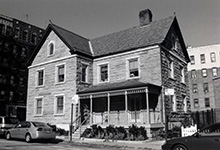

When Fordham University professor Donald Clarke bought his home on Grand Avenue between East 190th and 191st streets 40 years ago, the block was made up of large, three-story Victorian homes. Today, when he looks out his front windows, Clarke sees a row of newly-constructed multi-family buildings, housing eight families where just one single-family home used to be.
For better or worse, things are changing.
A widely-publicized "building boom" is taking place throughout the Bronx, and residents on Grand Avenue are feeling it more acutely than others, with four sites currently under construction between East 190th and 192nd streets.
All four lots appear to have permits for new three-family homes. Neighbors of the sites are all too familiar with this type of construction – 20 similar units were completed in their neighborhood over the last few years. One by one, big, distinct houses and yards have been bought up and demolished to make room for cookie-cutter townhouses that can be found all over the city.
The Bad and the Good
On a quiet, tree-lined avenue like Grand, a few small-scale construction projects can totally change the character of the neighborhood. Neighbors look back fondly on the large, turreted houses with wraparound porches that are now mostly gone.
At the same time, they say the influx of new homeowners and renters has brought some positive changes.
"There are now children on the block," said Clarke. "It’s a better mix of people."
Clarke’s next door neighbor, Luis Rios, said the neighborhood is safer now.
"Now you have more eyes, a whole bunch of people to pick up the phone if they see something," he said, pointing at the drab two-family homes across the street from him.
Rios, a Pentecostal minister at a Bryant Avenue church, bought his home in 1985 when he was transferred to the Bronx. The original owner of the estate that his house was built on specified in the deed that the property has to be occupied by a clergyman, Rios said.
Rios has been deluged with offers for his home, he said, but he wouldn’t consider selling. There’s no way he’d find a comparable property that he can afford, he said.
Clarke receives offers at least twice a week in the mail and has had developers knock on his door, he said. The notices usually say something like, "Keep us in mind if you plan to sell."
Although Clarke believes many of his neighbors sold their homes because they retired, he said aggressive approaches from developers may have sped up the process. He added that a previous wave of people left the area because they considered it unsafe.
When Clarke first moved to the Bronx to teach at Fordham, he needed a big house to accommodate his wife and seven children. Nowadays, he would be hard pressed to find that kind of space.
The Problems
Among the criticisms of the new row houses that are replacing the old Victorian homes on Grand Avenue and other parts of the neighborhood is that the bedrooms in the three-family homes are tiny. Homeowners or renters in the new units will be paying high rents for cramped spaces, where the construction is sometimes shoddy, say housing advocates.
The quality of the construction varies from one contractor to another, said Greg Lobo-Jost, deputy director of the University Neighborhood Housing Program, a nonprofit that works on affordable housing and homeownership issues in the northwest Bronx.
"We talked to some tenants who moved into a brand new apartment building who wanted to move right out because it was horrible construction and their apartments weren’t even working," Lobo-Jost said.
"Then there’s the aesthetic side of it. People all over the city are kind of upset at how ugly these three-family houses are, and they don’t fit in with the character of the neighborhood," he added. "I guess it’s what they call ‘infill housing,’ when you’re dealing with very scattered, smaller lots, here and there."
According to Lobo-Jost, the cost to homebuyers to renovate and maintain the original Victorian homes would be too great, so developers opt to tear them down and build three- or four-family homes on the lot, which is the maximum allowed under the current zoning.
"Obviously, when these houses were built, the neighborhood was a little different and you didn’t need as much money to get in," he said. "Now, in the real estate market in New York City, you need a pretty sizable income and savings to afford the mortgage payments on the inflated prices . . . So, with the cost to build in New York City so high, this is the only way they’re going to make back their money."
A History of Change
According to Bronx Borough Historian Lloyd Ultan, it’s not the first time large estates have been divided up into multiple homes. Around the turn of the century, large estates dominated the neighborhood. Much of Grand Avenue, he believes, was the Claflin estate, which stretched from Sedgwick Avenue almost to Jerome Avenue.
Those types of mansions eventually gave way as urbanization set in, Ultan said.
"The value of the land was going sky-high, and people were approached by private developers," he said. Property was divided up and more houses put in their place, much like now.
"Over a period of time, there’s a crying need for new and better housing to house more people, and as long as the zoning allows a higher density population" that trend will continue, he said.
For Ultan, it’s not necessarily a loss, in part because it provides homeownership opportunities. "It certainly would be a change in the character of the neighborhood though," he said, "because the neighborhood’s Victorian feel is going to be replaced by a 21st
century feel."
In Ultan’s view, none of the Grand Avenue homes meet the criteria for landmarking, a strategy that was used in Riverdale to preserve the Fieldston historic district.
The only other way to prevent more out-of-context development would be to change the zoning in the area to allow only single-family homes, as was done in Van Cortlandt Village and other neighborhoods.
In the absence of any push to "downzone" the neighborhood, holdouts like Clarke and Rios will continue to endure constant construction around them.
"The construction sites are the worst part – they believe they’re entitled to stop all traffic, they block everything," Clarke said. "They think nothing of damaging your sidewalk when they’re working,"

admin
Welcome to the Norwood News, a bi-weekly community newspaper that primarily serves the northwest Bronx communities of Norwood, Bedford Park, Fordham and University Heights. Through our Breaking Bronx blog, we focus on news and information for those neighborhoods, but aim to cover as much Bronx-related news as possible. Founded in 1988 by Mosholu Preservation Corporation, a not-for-profit affiliate of Montefiore Medical Center, the Norwood News began as a monthly and grew to a bi-weekly in 1994. In September 2003 the paper expanded to cover University Heights and now covers all the neighborhoods of Community District 7. The Norwood News exists to foster communication among citizens and organizations and to be a tool for neighborhood development efforts. The Norwood News runs the Bronx Youth Journalism Heard, a journalism training program for Bronx high school students. As you navigate this website, please let us know if you discover any glitches or if you have any suggestions. We’d love to hear from you. You can send e-mails to norwoodnews@norwoodnews.org or call us anytime (718) 324-4998.