


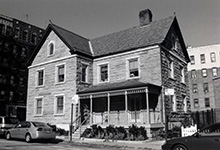

While exiting heavily-used St. James Park on a recent Sunday evening, young father, Jelani Ciria, was executed — shot in the chest at least six times — in broad daylight.
Somebody must have seen something.
That’s what police and family members as well as local political and religious leaders continue to believe. They are urging witnesses to come forward with any information that might aid investigators in their search for Ciria’s killers. A 15-year-old boy was also hit by a stray bullet, but is expected to fully recover.
“We all know who did this” said Ciria’s brother during a public prayer vigil two days after Ciria was murdered. “We just want somebody to go to jail. This was a hit, the Spanish Bloods, drug dealers. They came to the memorial and knocked over candles we had lit for Jelani.”
According to police, as Ciria, 20, left St. James Park, near the corner of 192nd Street and Creston Avenue, just after 6 p.m. on Sunday, Aug. 29, two unidentified males got out of a car on Creston Avenue and opened fire. Police said Ciria was shot about six or seven times, but the bullets left some 17 holes in his body.
“Make no mistake, this was a brutal homicide,” said Deputy Inspector John D’Adamo, the commanding officer of the 52nd Precinct. “It’s an atrocity.”
After being briefed on the details of the case, Monroe College Criminal Justice Professor Willford Pinkney, a former NYPD detective, said the murder was “retaliatory. The victim probably was not an innocent bystander and probably had a criminal record.”
According to a source who spoke to the Ciria family and who requested anonymity, Jelani had been on his way home from an inpatient substance abuse program on 167th Street and Franklin Avenue. Sunday was the one day a week Ciria was allowed to leave the program facilities to visit his family, the source said.
D’Adamo said Five-Two detectives were exploring a bunch of “fruitful leads,” but added that they needed the community’s help. “The public knows what’s going on out there,” he said. “It’s so frustrating.”
D’Adamo wanted to assure anyone who came forward that they will remain completely anonymous. He added that undocumented immigrants had nothing to fear in talking with police, who would not ask about their immigration status.
Last week, two days after the shooting, St. James Park clamored with youth engaged in pickup baseball and basketball games, couples walking their dogs and a playground teeming with young children.
Near the eastern edge of the park, a small gathering of political and religious leaders, members of the community and mourning family members held a prayer vigil.
Organized by City Councilman Fernando Cabrera and Bishop Fernando Rodriguez, the vigil was intended as the beginning steps for community action following Ciria’s murder, which underscored the borough’s rising murder rate.
Several speakers, including Cabrera and Ciria’s brother, pleaded with witnesses to come forward. Cabrera urged people to call police if they see anyone harboring illegal guns. “If these guns weren’t on the streets, this man wouldn’t have died.”
“You are going to continue being afraid if you don’t say something,” Cabrera added. “This is a form of terrorism, it is urban terrorism.”
State Senator Pedro Espada, Jr. also joined the vigil and announced that his office was offering a $5,000 reward to anyone who provided information leading to the arrest of Ciria’s murderer — in addition to the $2,000 the NYPD offers for any information that leads to an arrest in a violent crime.
Getting people to come forward isn’t as easy as it sounds, Pinkney said.
The killers probably know “eyewitnesses won’t say anything,” Pinkney said. “Witnesses probably live in the same neighborhood as the killers or are usually immigrants afraid of being deported. If you testify people will see your face, get your name and address.”
While Pinkney understands people’s fears, he also said the public doesn’t realize that it is the police department’s job to protect witnesses. “Realistic discussions need to be had between the community and police about the rights and protections of those in the public that come forward,” he said.

admin
Welcome to the Norwood News, a bi-weekly community newspaper that primarily serves the northwest Bronx communities of Norwood, Bedford Park, Fordham and University Heights. Through our Breaking Bronx blog, we focus on news and information for those neighborhoods, but aim to cover as much Bronx-related news as possible. Founded in 1988 by Mosholu Preservation Corporation, a not-for-profit affiliate of Montefiore Medical Center, the Norwood News began as a monthly and grew to a bi-weekly in 1994. In September 2003 the paper expanded to cover University Heights and now covers all the neighborhoods of Community District 7. The Norwood News exists to foster communication among citizens and organizations and to be a tool for neighborhood development efforts. The Norwood News runs the Bronx Youth Journalism Heard, a journalism training program for Bronx high school students. As you navigate this website, please let us know if you discover any glitches or if you have any suggestions. We’d love to hear from you. You can send e-mails to norwoodnews@norwoodnews.org or call us anytime (718) 324-4998.