


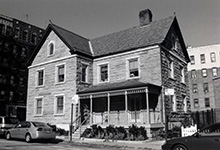

Before 1973, the gritty, sparsely-populated, heavy-commercial feel of Webster Avenue fit nicely under the rattling tracks of the elevated train that ran from the north Bronx into Manhattan. But now, 37 years after the tracks were removed, many local residents feel the wide north-south corridor’s grimy aesthetic is outdated and in dire need of a makeover.
“Nobody likes this corridor,” said Nick Napolitano, who lives nearby in Norwood and graduated from Fordham University, which runs parallel with Webster. “It’s kind of gross and depressive there. Not a nice place to walk around.”
Nearly four years ago, members of Community Board 7, made up of 30-plus local volunteers including Napolitano, decided to do something about it.
Initially, the board wanted to take a look at the entire community district and do a comprehensive rezoning plan, called a 197-A. But lacking the funds to complete it, the board instead decided to take a piecemeal approach, starting with Webster and some of the surrounding neighborhoods in Norwood and Bedford Park.
“We wanted to change what could be built there,” said board member Sandra Erickson, who used to chair the land use committee. “People wanted to see some mixed-use development.”
The board enlisted the help of the Department of City Planning, and over the the past three and a half years, devised a limited rezoning plan (called a 197-C) that would better fit the needs of the area.
Board members say Webster — with its proximity to the Bronx River, the New York Botanical Garden, Bronx Zoo, Fordham, Montefiore Medical Center and two Metro North stops — is full of potential that is being stifled by its zoning regulations, which discourages, and even prohibits, residential development.
The new rezoning plan, completed this spring and now entering the city’s uniform land use review process (ULURP), is twofold.
First, the idea is to “upzone” Webster from its heavy commercial designation (as are most corridors underneath train tracks) to a more residential and retail-friendly zoning. At the same time, select blocks in Norwood and Bedford Park have been “downzoned” to preserve the low-density, low-rise feel that residents say is vital to the character of these neighborhoods.
Board members say they are pleased with the preliminary rezoning plan.
“I saw the plan, it looks great,” said Napolitano.
“[City Planning] has been very receptive to the voices in the community and the needs of the community,” said current land use chair Ozzie Brown, who envisions a revamped Webster with a more “village” feel, full of sidewalk cafes, restaurants, art galleries and other social and cultural institutions. “Why can’t we celebrate the arts?” he asks.
Brown says the area’s main commercial corridor, Fordham Road, shuts down at night and that there is a general lack of nightlife in the north Bronx. He believes Webster could fill that void in time.
Board member Jay Shuffield, who lives in Norwood and is an urban planner by trade, says “he couldn’t agree more” with Brown’s vision for Webster. “You run into everyone from the neighborhood somewhere else because we don’t have the options here in our own community,” he said in an e-mail.
Brown and others realize the change won’t happen overnight. Zoning, Brown said, can’t “dictate the rate which development occurs, but it provides the context for [what] can occur.”
“Change happens slowly,” said Erickson, who owns several properties in the borough. The rezoning combined with what she sees as a coming drop in prices and a receptive community board, will lure buyers into creating the type of development the board envisions, she said.
A spokesperson for City Planning pointed to how a similar rezoning of 13 blocks in Morrisania surrounding Third Avenue, from 163rd to 168th streets, completed in 2003, has already produced promising results, including 665 new units of affordable housing and commercial space.
In May, City Planning began the land review process with a meeting to hear any community concerns about the plan and to discuss the scope of the draft environmental impact statement (the DEIS, which is a study of how the rezoning will impact the area). About 30 people attended and five spoke.
At the hearing, Barbara Stronczer, a board member who lives near Webster and spoke on behalf of the Bedford Mosholu Community Association, said the association is concerned about creating too much population density on Webster and would like to see stricter limits on the size of any new developments.
Napolitano said he worries that some of the auto shops and other existing commerical businesses might be forced out by the new zoning regulations. The new zoning wouldn’t necessarily force existing businesses to move, but they might, for example, entice developers to buy up commercial-only properties, knock them down and create something entirely new, like a housing complex. (City planning said it would not be studying the socio-economic impact of the plan because it feels effects will be limited.)
Shuffield said he would like to see a plan in place to help the existing businesses find a home without pushing them into neighborhoods that may not want them. “We shouldn’t have to choose between doing nothing to improve our community and putting someone else’s neighborhood at risk,” he said.
The final impact statement and zoning plan, which City Planning said will take into account all the comments and suggestions, should be completed by September. After that, there will be ample opportunity for residents to weigh in on the plan at upcoming hearings.

admin
Welcome to the Norwood News, a bi-weekly community newspaper that primarily serves the northwest Bronx communities of Norwood, Bedford Park, Fordham and University Heights. Through our Breaking Bronx blog, we focus on news and information for those neighborhoods, but aim to cover as much Bronx-related news as possible. Founded in 1988 by Mosholu Preservation Corporation, a not-for-profit affiliate of Montefiore Medical Center, the Norwood News began as a monthly and grew to a bi-weekly in 1994. In September 2003 the paper expanded to cover University Heights and now covers all the neighborhoods of Community District 7. The Norwood News exists to foster communication among citizens and organizations and to be a tool for neighborhood development efforts. The Norwood News runs the Bronx Youth Journalism Heard, a journalism training program for Bronx high school students. As you navigate this website, please let us know if you discover any glitches or if you have any suggestions. We’d love to hear from you. You can send e-mails to norwoodnews@norwoodnews.org or call us anytime (718) 324-4998.