


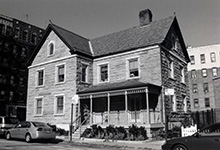

Among the many traditions that Filipino parishioners have brought to the Parish of St. Ann is the “Misa de Gallo,” or “Rooster Mass.” This is a novena – a series of nine masses — that begin at 6 a.m. on each of the nine days leading up to Christmas.
“It’s very traditional,” says Leticia Gedubig, who came to the United States from the Philippines in 1971. “It’s what I grew up with, but we only recently started doing it here.”
In the Philippines, where the majority of the population is Catholic, the Misa de Gallo begins at 3 a.m. (before the rooster crows) to allow farmers to attend the service before work. Last year, St. Ann’s concluded each early Misa de Gallo with sweets and hot drinks.
Filipino faces are relatively new to St. Ann’s parish, which was founded in 1927 on Bainbridge Avenue near Gun Hill Road. The once-dominant Irish population is now dwindling, and since the 1980s, the large Puerto Rican contingent has been joined by Latinos from Central and South America and, increasingly, by Filipinos.
“Of 30 students at last summer’s Bible school, seven or eight were Filipino,” says Father Francis Scanlon, the church’s pastor. “That’s a huge change from 30 years ago.”
The St. Ann Choir, the church’s primary choir that sings at weekly worship services, is almost entirely Filipino. The St. Ann Novena Choir, which sings only monthly and on special occasions like the annual St. Ann Novena in the summer, is about half Filipino and includes singers from various countries, such as Trinidad, Portugal and Jamaica.
For many of the Filipino members, St. Ann’s is more than a place for religious observance. It is a place to build new relationships in a new country and also a place to preserve a national identity while assimilating into a new one.
“Filipinos are people who don’t like to stick out,” says Novena Choir member Carlos Espiritu, who is Filipino and a pediatrician. “On the one hand that’s good, because our community doesn’t have a segregated feel, but on the other hand, we are more at risk for losing our identity. The choir addresses that because we sing together and we celebrate in our own way, but we are open to anyone and we join with parishioners of all backgrounds.”
Rosalie Cabrera arrived in New York from the Philippines in 1988, hoping to advance her career in health care. In the Philippines, she says, her co-workers would perform daily masses, which included hymns, in the public areas of their hospital. She remembers fondly how patients would pack the hallways to listen and participate.
When Gedubig, then the leader of the staff choir at Montefiore Medical Center (which has its main entrance just across the street from St. Ann’s), asked her to sing in the hospital’s masses about seven or eight years ago, Cabrera agreed.
Soon after, Gedubig approached Monsignor Robert Trainor, St. Ann’s pastor at the time, with a proposal for a musical collaboration. The Montefiore choir became and still remains the St. Ann Novena Choir. (The Novena choir is fully made up of St. Ann’s members and no longer has any formal affiliation with Montefiore.)
Cabrera says “the church is like a family.” She keeps a photo album documenting her fellow choir members’ life celebrations — baptisms, weddings, Christmas parties — and speaks enthusiastically about how they have provided stability in her shifting life here in the States.
Others choir members agree. “After a week of work, choir practices are like therapy,” Espiritu says.
He recalls the experience of caroling in nursing homes with the Novena Choir on Christmas Day two years ago as one of the group’s most satisfying performances. “You should’ve seen the faces,” he says of the nursing home residents. “Some of them had tears in their eyes.”
It isn’t only special occasions that bring the parishioners together. Sundays after the noon Mass, St. Ann Choir member Remy Lazo prepares lunch for her fellow singers. Only after the friends have enjoyed the home cooking — often traditional Filipino dishes such as thick soup with eggs or noodles with shrimp — do they squeeze around the Lazo family’s upright piano to sing.
The choir has already begun preparation for this year’s Christmas performances. Practice for the Christmas concert, which features both choirs, started in mid-November. An effort is also being made to organize more caroling in nursing homes this holiday season.
In all seasons, what choir members value most is the way that the music has built their community and, consequently, increased year-round mass attendance. “We’re really more like a family than a choir,” said Espiritu. Then he laughed and added, “How else could we spend more time eating than singing?”

admin
Welcome to the Norwood News, a bi-weekly community newspaper that primarily serves the northwest Bronx communities of Norwood, Bedford Park, Fordham and University Heights. Through our Breaking Bronx blog, we focus on news and information for those neighborhoods, but aim to cover as much Bronx-related news as possible. Founded in 1988 by Mosholu Preservation Corporation, a not-for-profit affiliate of Montefiore Medical Center, the Norwood News began as a monthly and grew to a bi-weekly in 1994. In September 2003 the paper expanded to cover University Heights and now covers all the neighborhoods of Community District 7. The Norwood News exists to foster communication among citizens and organizations and to be a tool for neighborhood development efforts. The Norwood News runs the Bronx Youth Journalism Heard, a journalism training program for Bronx high school students. As you navigate this website, please let us know if you discover any glitches or if you have any suggestions. We’d love to hear from you. You can send e-mails to norwoodnews@norwoodnews.org or call us anytime (718) 324-4998.