



Editor’s Note: This story was updated and corrected from an earlier version on June 17, 2009.
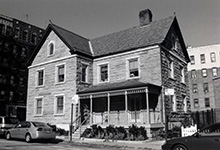
The city’s Health Department says it is looking into a compromise that might split the vacant old Fordham Library into a multi-use facility, a sign of hope for local politicians and activists who were outraged last fall when the city said it was planning to turn the building into a full-service animal shelter.
For the past two years, Sistas and Brothas United, a youth activist group affiliated with the Northwest Bronx Community and Clergy Coalition, has lobbied for the space to be turned into an arts and technology center for community use.
Local Councilman Joel Rivera, members of Community Board 7 and another group, Community Action Unlimited, have also worked to see the building turned over for community use.
“Right now we’re in conversations with the Health Department and the mayor’s office about turning at least some of that space over to the community,” Rivera said recently. “It’s something I’m willing to put capital dollars [from the Council budget] into.”
In an e-mail, Celina De leon, a spokesperson for the Health Department, said the agency needs about 15,000 square feet for a full-service animal shelter, which would only take up a little more than half of the library building’s 27,400 square feet and leave the remaining space open for other types of programming.
City law mandates the agency open full-service shelters in every borough and the Bronx currently doesn’t have one.
But De leon also indicated that there might be a less costly alternative, one that Rivera and pet advocates are pushing for at City Hall. Rivera says, and De leon confirmed, that a low-cost spay and neuter facility would require only about 2,000 square feet of space.
It would also be less costly to build and maintain and, at the same time, save the lives of thousands of animals each year, advocates say.
“[Implementing low-cost spay and neuter clinics] will not only save lives, but it will also save the city money.” said Catherine Beason, the executive director of Animal Friendly NYC, a nonprofit political action group.
The city takes in around 40,000 homeless cats and dogs every year, according to the Animal Care and Control Center, which runs the city’s animal shelters.
If the shelters can’t find owners for the animals, they are put to sleep, usually within a week of when they arrive; 39 percent of cats and 28 percent of dogs are euthanized once they reach the shelter, according to city figures.
The cost of taking in a dog or cat is about $200 for the city, Beason said, regardless of whether they’re adopted or euthanized. The cost of spaying or neutering a pet at a city-subsidized clinic could be as low as $65, she said.
A decade ago, Beason said the animal rescue community was focused on adoption, but now the emphasis is shifting to prevention — stopping more animals from being left out on the street. The best way to do that, Beason said, is to prevent pets from getting pregnant and having offspring, which are often abandoned by the time they reach sexual maturity.
Abandonment is more of a problem in low-income neighborhoods, Beason said, where owners are less likely to spay or neuter their pets.
A study in the Journal of the Veterinary Medical Association, released in April, said cat-owning families with an income of $35,000 or less are almost are twice as unlikely to get their cats fixed than those making more than $35,000. It’s simple economics, Beason said. Getting your pet fixed is expensive, as much $600 to $700 for a big dog.
That could change, Beason said, if the city decides to change its approach to dealing with homeless pets and funds low-cost spay and neuter clinics around the city.
Rivera said Harlem Councilwoman Inez Dickens has already introduced legislation to repeal the shelter mandate and promote spay and neuter clinics. This has not yet been confirmed, but Rivera said, in any case, the Council won’t get to it until at least after the budget is hammered out in June.
In the meantime, the Health Department isn’t rushing to renovate the library building. “There’s no movement there yet, which is a positive thing,” Rivera said.

admin
Welcome to the Norwood News, a bi-weekly community newspaper that primarily serves the northwest Bronx communities of Norwood, Bedford Park, Fordham and University Heights. Through our Breaking Bronx blog, we focus on news and information for those neighborhoods, but aim to cover as much Bronx-related news as possible. Founded in 1988 by Mosholu Preservation Corporation, a not-for-profit affiliate of Montefiore Medical Center, the Norwood News began as a monthly and grew to a bi-weekly in 1994. In September 2003 the paper expanded to cover University Heights and now covers all the neighborhoods of Community District 7. The Norwood News exists to foster communication among citizens and organizations and to be a tool for neighborhood development efforts. The Norwood News runs the Bronx Youth Journalism Heard, a journalism training program for Bronx high school students. As you navigate this website, please let us know if you discover any glitches or if you have any suggestions. We’d love to hear from you. You can send e-mails to norwoodnews@norwoodnews.org or call us anytime (718) 324-4998.