


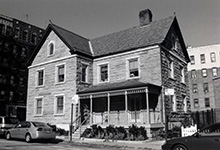

It’s lunchtime on the Tuesday before Thanksgiving and a 100-plus-pound bird sits in the oven. Outside, the dining hall is packed with more than just the usual faces. “We have so much here to be thankful for,” says Lillian Flachofsky, a regular at the Sister Annunciata Bethel Senior Center in Bedford Park. “I’d really miss the center if they closed it. It’s like a family to me.”
But as the November holiday comes to pass, the future of the Bedford Park senior center, and others in the area, is uncertain. Backed by Mayor Michael Bloomberg’s administration, the plan proposed by the Department for the Aging (DFTA) to “modernize” the way the city organizes its senior center budgeting could result in closures of up to 90 centers citywide, a loss of more than a quarter of the city’s 329 centers.
The new plan calls for all senior centers to be divided into two categories: smaller neighborhood centers and larger senior hubs. Neighborhood centers are expected to serve 75 meals a day and offer three daily activity options, all on a yearly budget of $500,000. Hubs will receive twice as much in funding, but with the requirement that they provide 200 meals each day and offer six activity options.
Aside from Bedford Park, which serves, on average, 75 meals to seniors per day, two other senior centers are located within Community District 7, the Tolentine Zeiser Senior Center in University Heights, which serves 70 meals a day, and the Mosholu Montefiore Senior Center in Norwood, which serves 95 meals a day.
At a minimum, the DFTA says it anticipates funding 225 neighborhood centers and 15 hubs.
Bronx Assemblyman Jeffrey Dinowitz sees only one possible outcome from the city’s plan. “There’s going to be a whole lot less senior centers,” he said. “The budget of every single center is going to be slashed or cut and that means fewer services for seniors.”
DFTA says it needs to modernize because 44 percent of all the city’s senior centers are underutilized. This statistic is mostly based on how many meals each center serves. Some 25,000 people regularly use the city’s senior centers. Only two percent of the more than 1.3 million seniors living in the city take advantage of the meals offered at centers, according to the DFTA. Last year, eight million meals were served, or one million less than was budgeted for.
“If indeed there are centers that are underutilized, take steps to encourage the use of those centers,” Dinowitz said. “We want to encourage people to go to centers.”
Under the new plan, the process in which the DFTA will award new contracts will require centers to complete a Request for Proposals (RFP) and submit it to the agency by Jan. 23. In each RFP, centers will apply for one of the two proposed categories and outline the scope of the services they will provide to seniors.
To help facilitate the RFP process, a bidder’s conference is scheduled for Dec. 2. The conference is intended to provide bidders (senior centers) with an opportunity to increase networking and the exchange of information.
But coupled with the worsening economic climate, the RFP has everyone involved in senior centers worried about what the future holds for an ever-increasing elderly population.
“They’re all very nervous,” said Councilman Oliver Koppell, referring to the local senior center directors he recently hosted at his office. The prospect of reduced funding is “a very serious problem,” he said.
“The reorganization has created great uncertainty as to what direction the delivery of senior services will take, and whether some senior centers will be forced to close,” Koppell said in an earlier statement. “Balancing the budget on the backs of seniors is unconscionable.”
Bobbie Sackman, the director of public policy for the Council of Senior Centers and Services of NYC, wants the RFP rescinded by the city. Believing “the whole process is flawed,” especially the timing, Sackman argued that there should be no rush to conclude any reorganization process. “We’re just saying to [the city] ‘step back and take a deep breath,’” she added.
While Sackman and City Council members work on a plan to prevent the closures of senior centers throughout the city, Flachofsky has already started work on keeping her beloved senior center open and operating. She’s praying.
Flachofsky, who has frequented the Bedford Park Senior Center almost daily for two years, credits the center for keeping her active. In 2000, when her twin sister passed away, Flachofsky became reclusive and suffered from depression.
“At first I didn’t want to come here, but I’m glad I did,” she said. “I pray they keep it open. If you lose this place, it’d be a hurt to a lot of us. It would really be a heartbreak.”

admin
Welcome to the Norwood News, a bi-weekly community newspaper that primarily serves the northwest Bronx communities of Norwood, Bedford Park, Fordham and University Heights. Through our Breaking Bronx blog, we focus on news and information for those neighborhoods, but aim to cover as much Bronx-related news as possible. Founded in 1988 by Mosholu Preservation Corporation, a not-for-profit affiliate of Montefiore Medical Center, the Norwood News began as a monthly and grew to a bi-weekly in 1994. In September 2003 the paper expanded to cover University Heights and now covers all the neighborhoods of Community District 7. The Norwood News exists to foster communication among citizens and organizations and to be a tool for neighborhood development efforts. The Norwood News runs the Bronx Youth Journalism Heard, a journalism training program for Bronx high school students. As you navigate this website, please let us know if you discover any glitches or if you have any suggestions. We’d love to hear from you. You can send e-mails to norwoodnews@norwoodnews.org or call us anytime (718) 324-4998.