


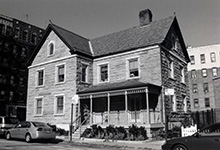

 A new program to be implemented at DeWitt Clinton High School as soon as this fall will keep thousands of students from buying lunch and other items on Jerome Avenue.
The merchants have a complicated relationship with the students. Many complain about student behavior and general hanging out, but they rely on teen purchasing power to sustain their businesses.
Clinton intends to expand its cafeteria this summer to accommodate all 4,500 students. The school, located on Mosholu Parkway South in Bedford Park is introducing a “captive lunch,” following the trend among large high schools that bar students, due to safety concerns, from leaving school property at lunchtime. The move will dramatically change the troubled, but profitable, symbiosis between area merchants and students.
Students may sometimes irritate Ana Justiniano, manager of a Burger King on Jerome Avenue, but she’d rather have them around than not. “It would be good if they behaved better, but they are most of our business,” she said.
But Eun Sook Kim, manager of the Twin Donut on Jerome Avenue, says he won’t miss the Clinton students. He thinks the kids deter business from adults, who tend to buy more. “They are very disrespectful,” said Kim, who speaks Korean, through a translator. “They are so bad, why even have them come in?”
Kim, who has managed the store for four years, says teens often act out, prompting him to call the police five times a day.
Edgar Carallo, manager of Caruso Pizza up the street, also calls the cops occasionally. “I tell [the students] I need the tables, but they just stay for two or three hours,” Carallo said. “They see me call the police and then they leave.”
Instead of calling the cops, Justiniano retains a security guard during school hours.
But for all the headaches, Clinton students are a driving force behind the robust local economy. “A lot of the merchants benefit from a non-captive lunch,” said Roberto Garcia, executive director of the Jerome-Gun Hill Business Improvement District (BID). In addition to restaurants and delis, Garcia said students also make a lot of visits to apparel stores. “Kids may be irritating, but they are consumers,” Garcia said.
Geraldine Ambrosio, Clinton’s principal, emphasized that fact. “If each of my kids spends a dollar, that’s $4,500 going to the community,” she said. Ambrosio estimated that just under half of students eat the school lunch, which extends for six periods beginning at 10 a.m. City figures, however, state that only one-fifth of students remain inside.
In a small survey of Clinton students, not one said they ate the school lunch regularly. “I don’t eat [in the cafeteria]. No one I know does,” said Jacquelle Morgan, 16.
Students said the lunch lacked variety and was improperly cooked. “You’ve read Fast Food Nation … it’s not sanitary,” said Salem Mohamed, 17, referring to the food industry expose. Mohamed says he and most of his friends eat at home.
Most students, though, prefer the pizza, fast food, and Chinese restaurants lining the commercial strip, which runs between Mosholu Parkway and Gun Hill Road. “I haven’t eaten school lunch since I was in elementary school,” said Crystal Morel, 15.
The lunch menu is out of Clinton’s hands, and Ambrosio wasn’t surprised to hear about student complaints, though a sample menu did include plenty of variety, including sandwiches, salads, and other entrees, along with the fast food options that teens tend to prefer.
But the cafeteria’s inadequate space is something the school can address. Beginning this summer, the school will shift some of its classroom space to build a larger facility, according to Ambrosio. Most other large high schools in the area, such as Evander Childs and Walton, already have one in place. In general, safety concerns at Clinton, a leader among local high schools in graduation rates, have not been as serious as at other schools. But gangs are reportedly more of a factor lately, grimly highlighted last month when a teen attacked and killed a Clinton student with a machete on the No. 4 train. The teens were allegedly in rival gangs.
Clinton will probably install metal detectors this summer. The borough president has also allocated funds to install surveillance cameras at the school.
As for now, Ambrosio says school security more frequently patrols the merchant strip and the path leading to it from Clinton. Merchants say they’ve also seen more of a police presence in the area lately.
Surveillance cameras installed in the area by the BID seem to be helping, said Garcia. (Disclosure: The BID is managed by the Mosholu Preservation Corporation, publisher of the Norwood News.) The cameras feed directly to the precinct.
Though the focus might be on current Clinton students, almost everyone agrees that problems in the commercial area are also fueled by teens who have dropped out and adult vagrants congregating inside stores. Drug dealing is also a problem, according to Garcia, evidenced by small, empty marijuana pouches that can sometimes be found lying in the street.
Most merchants will admit that the percentage of Clinton students who are problematic is small. “It’s two groups who come and make trouble,” Carallo said. “Most make a line, sit and eat for 10 minutes, and leave.”
But, when the captive lunch debuts, the issues on Jerome Avenue will almost certainly take a different turn, one that won’t make either side happy.
“It’s going to be a serious economic loss to Jerome Avenue,” Ambrosio said.

admin
Welcome to the Norwood News, a bi-weekly community newspaper that primarily serves the northwest Bronx communities of Norwood, Bedford Park, Fordham and University Heights. Through our Breaking Bronx blog, we focus on news and information for those neighborhoods, but aim to cover as much Bronx-related news as possible. Founded in 1988 by Mosholu Preservation Corporation, a not-for-profit affiliate of Montefiore Medical Center, the Norwood News began as a monthly and grew to a bi-weekly in 1994. In September 2003 the paper expanded to cover University Heights and now covers all the neighborhoods of Community District 7. The Norwood News exists to foster communication among citizens and organizations and to be a tool for neighborhood development efforts. The Norwood News runs the Bronx Youth Journalism Heard, a journalism training program for Bronx high school students. As you navigate this website, please let us know if you discover any glitches or if you have any suggestions. We’d love to hear from you. You can send e-mails to norwoodnews@norwoodnews.org or call us anytime (718) 324-4998.