


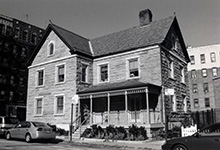

 Staff of the Northwest Bronx Community and Clergy Coalition don’t like seeing their names in print. In fact, the grassroots group has a strict policy that organizers aren’t to be quoted in the media. That’s so residents, the “leaders” of the organization, can speak for themselves.
So, after 19 years at the Coalition, beginning as an organizer in Norwood and ending as executive director, there is little on the record to document Mary Dailey’s career.
Nonetheless, Dailey, who left her job in May, made an impression on the neighborhoods she worked in and the people she worked with.
She started at the Coalition in 1986 after leaving a job at a Central American solidarity organization that barely paid her. “Survival” is how she described her move from that job to organizing for the Coalition in Norwood.
There was no shortage of tasks to take on. At the time, when crack was devastating lives and whole buildings, the Coalition led a “Drugs Out” campaign. In Norwood, that meant getting the 52nd Precinct to do a better job policing crime-ridden sections of the neighborhood.
Dailey’s biggest campaign in Norwood was battling a state-sanctioned rent increase known as MCIs (major capital improvements), which allowed landlords to pass on the cost of boiler, roof and other renovations to their tenants. Dailey remembers many widows who had little to live off but their husband’s Social Security being frightened by the increases. Many tenants also felt that their buildings were otherwise poorly maintained. The issue struck a nerve as Dailey knocked on doors and organized tenant associations.
“We had several meetings of two to 300 people from Norwood on that issue,” she remembers.
Dailey, 44, says the MCI issue was “a way to build a base, to get a whole bunch of people on the same page about what they were going through simultaneously.”
The group didn’t get everything they wanted but their work “radically changed the way DHCR [state Division of Housing and Community Renewal] would review [the MCI] applications,” Dailey said. Landlords were discovered to have lied on the applications about the cost and extent of the work. Eventually, the state stretched the amortization of the loan from five to seven years.
Myra Goggins, a Coalition board member who got involved in the organization around this time, said Dailey led by example.
“I don’t think Mary ever just considered it a job,” she said. “She was dedicated to a cause of just trying to make things right in the world. And this comes across to people and inspires you to try to do the best you can also.”
Dailey’s next stop as an organizer at the Associations from Fordham to Burnside, another Coalition affiliate, featured a marriage of her work on housing and crime. Instead of just getting police to target street-level dealers, Dailey and community residents trained their sites on neglected city-owned apartment buildings that were havens for drug dealers.Through their organizing, they were able to help move many buildings into stable management, such as with the Fordham Bedford Housing Corporation, a nonprofit.
After becoming executive director in 1994, Dailey put the organization on a more financially sound footing, increasing the organization’s annual budget by about $1.5 million through foundation grants.
That stability allowed the organization to think more strategically, rather than just react to problems. The Coalition joined and helped form citywide coalitions on education and housing.
“The value of neighborhood organizing is limited if you can’t connect the issues of people on the ground to some kind of greater change,” Dailey said.
She is particularly proud of the group’s involvement in coalitions that pushed the city to adopt a new housing inspection plan that will rely on community input.
Dailey says perhaps her biggest challenge was to make sure that the organization’s youth organizing was actually developing leadership among young people and working on social justice issues rather than providing youth services already provided by other organizations. Perhaps the ultimate success of these efforts was when the Coalition’s youth organization, Sistas and Brothas United, created a public high school focused on youth leadership (see p. 7).
And as she prepared to leave the organization, Dailey began to change how the Coalition is structured. While it has long tried to have at least one community organizer staffing each of nine neighborhood offices, that staffing level has been difficult to maintain financially and has also meant that some neighborhoods have gone without staff for months or years. This combined with the group’s desire to provide its staff with competitive salaries resulted in a plan to have organizing staff in four regions.
Dailey now works with the Center for Community Change, a national group. “I’ll be working to get organizations in the northeast that engage in grassroots and institutional-based organizing to build relationships with one another so they can be more effective in changing public policy,” she said.
Looking back on her long tenure at the Coalition, Dailey said she was lucky to work for an organization that already had a well-established culture of inclusiveness and diversity.
“I just hope I contributed to it being an environment that people could come in and work together and get a lot done,” she said.

admin
Welcome to the Norwood News, a bi-weekly community newspaper that primarily serves the northwest Bronx communities of Norwood, Bedford Park, Fordham and University Heights. Through our Breaking Bronx blog, we focus on news and information for those neighborhoods, but aim to cover as much Bronx-related news as possible. Founded in 1988 by Mosholu Preservation Corporation, a not-for-profit affiliate of Montefiore Medical Center, the Norwood News began as a monthly and grew to a bi-weekly in 1994. In September 2003 the paper expanded to cover University Heights and now covers all the neighborhoods of Community District 7. The Norwood News exists to foster communication among citizens and organizations and to be a tool for neighborhood development efforts. The Norwood News runs the Bronx Youth Journalism Heard, a journalism training program for Bronx high school students. As you navigate this website, please let us know if you discover any glitches or if you have any suggestions. We’d love to hear from you. You can send e-mails to norwoodnews@norwoodnews.org or call us anytime (718) 324-4998.