


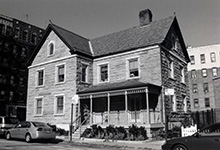

In the past two months, Deputy Inspector Joseph Hoch, the commanding officer of the 52nd Precinct, has lost four cops temporarily to the threat of AIDS.
Each of the four officers, including the precinct’s Special Operations Lieutenant Jerry O’Sullivan, was deemed by the Police Departmentat to be at risk of contracting the immune-system-destroying virus after being assaulted on the job. They were either punctured by a hypodermic needle or shared open wounds during the course of fights with suspects. They have been placed on medical leave and given anti-viral drugs.
“It’s a precautionary measure,” Hoch said. “They are immediately put on that stuff.”
That “stuff” is the AIDS cocktail, a potent and nauseating combination of three AIDS drugs. It’s the same cocktail that doctors give patients who have already contracted the virus.
It’s an interesting and terrifying by-product of Operation Impact, which flooded the Five-Two with 100 new officers over the summer. With an increased police presence on the street, there are more possibilities for confrontation and violence against officers, said Hoch.
While crime in the Five-Two is down overall, assaults are up, mostly due to domestic violence and attacks on police officers, Hoch said.
Dr. Barry Zingman, medical director of the AIDS Center at Montefiore Medical Center and has been working in the AIDS field since it became a field in the early 1980s, said the precautionary administering of the AIDS cocktail is also common practice at hospitals, where the risk of exposure to the virus is high as well.
Rarely, Zingman said, do these exposures result in positive tests. But taking the AIDS cocktail helps people psychologically more than anything else.
“They are often scared and upset,” Zingman said about those exposed to a possibility of contracting the virus. “It introduces a tremendous amount of unknown into their lives.”
Medically speaking, Zingman said, taking the cocktail early after an exposure has proven to be 80 percent effective, but that it’s probably much higher.
According to Zingman, only 2 percent of Bronxites are infected with the HIV virus, which means that most of the time a random exposure to a used hypodermic needle or the mixing of blood with another person would not result in transmission of the virus.
But cops are often dealing with criminals and known drug abusers, which puts police officers at a higher risk when they’re exposed on the streets.
Hoch said he doesn’t know of any officers who have ever actually contracted the virus from contact in the field, and Zingman maintains that it’s an extremely remote possibility. The NYPD press office didn’t respond to a Norwood News query asking if any officer in the city had ever contracted the virus from contact in the field.
Hoch feels for his cops and laments the fact that he’s losing officers, who are out at least a month after exposure. After a month on the cocktail, officers are tested for the virus again. Six months later, they are tested again,
He said these exposures were not the result of bad training or tactics; they simply happened during the course of being a cop.
“This, unfortunately, goes with the territory of what we do,” said Hoch.

admin
Welcome to the Norwood News, a bi-weekly community newspaper that primarily serves the northwest Bronx communities of Norwood, Bedford Park, Fordham and University Heights. Through our Breaking Bronx blog, we focus on news and information for those neighborhoods, but aim to cover as much Bronx-related news as possible. Founded in 1988 by Mosholu Preservation Corporation, a not-for-profit affiliate of Montefiore Medical Center, the Norwood News began as a monthly and grew to a bi-weekly in 1994. In September 2003 the paper expanded to cover University Heights and now covers all the neighborhoods of Community District 7. The Norwood News exists to foster communication among citizens and organizations and to be a tool for neighborhood development efforts. The Norwood News runs the Bronx Youth Journalism Heard, a journalism training program for Bronx high school students. As you navigate this website, please let us know if you discover any glitches or if you have any suggestions. We’d love to hear from you. You can send e-mails to norwoodnews@norwoodnews.org or call us anytime (718) 324-4998.