

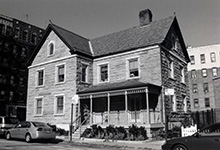

John Reilly loves his home on 202nd Street near the Grand Concourse, the home his grandfather purchased that now houses a fourth generation of Reilly’s. But while he never considered the house to be on beachfront property, his insurance company, Allstate, decided the home was too close to the Atlantic coast and for that reason would not renew his policy after over 20 years of coverage.
Allstate has determined the eight counties of New York along the Atlantic coastline to be at particularly high risk for damage from hurricanes and flooding. In light of recent hurricane destruction in other parts of the U.S., Allstate feels it has to limit its exposure.
Reilly is one of as many as 28,000 homeowners in the coastal counties to receive notices of non-renewal at the anniversary of their three-year policy. The company began ending policies to reduce risk in October 2005, said Krista Conte, an Allstate spokesperson.
“This is not an issue of profitability,” Conte said. “Allstate insures 26 percent, or one in four homes. We must manage our risk in order to preserve our promise to our policyholders. Allstate has the lion’s share [of the market] and home values in those areas are high.”
According to the New York State Insurance Department, 142 companies write home insurance policies in the state, seven belonging to Allstate, which holds 20 percent of the market share.
When an Allstate homeowner’s policy comes to the end of its term, the company said it considers several criteria when deciding whether to offer renewal. For example, coastal homeowners that have made previous claims or have wood-framed homes may receive notices of non-renewal. In some cases, homeowners who also carry auto or life insurance policies may receive a renewal, but only if those other policies were added before October 2005.
But Allstate employees at the Neill Avenue office in the Bronx know of homeowners with no previous claims who also received non-renewal notices. Office manager Francesca Reilly (no relation to John) also said clients who had multi-line policies and received non-renewals on their home policies are taking the rest of their business elsewhere.
“It’s definitely hurting us,” Francesca Reilly said. “It pulls a lot of business away. And why should they stay?”
Most customers in this area switch to secondary insurers such as Tower, one of five other insurance companies operated by Allstate. Rates with these secondary companies tend to be higher, Francesca Reilly said.
Another broker, Regina Floria, from an Allstate office on Webster Avenue, said she sees three to five homeowners switch to Tower each week.
Homeowners may find they also do not qualify for Tower’s higher priced coverage. Those individuals have no alternative but to apply to the state for coverage offered by the New York Property Underwriting Association. This process involves a hearing to determine eligibility and offers only minimal coverage. The rate tends to be 5 percent higher than the market.
State Senator Jeff Klein began investigating non-renewal by insurers after receiving calls from his constituents in Edgewater and City Island last year. He claims insurance companies are cherry picking customers.
“There was no rhyme or reason to why homeowners were losing their policies,” Klein said. “Some had never made a claim and had been with the same company for 20 years.”
Klein introduced legislation in Albany last April directing the New York State Superintendent of Insurance to slow the rate at which insurers may decide not to renew home policies. In a press release, Klein called the non-renewal trend “unfair” and the insurance companies “out-of-control.” But the legislation was tabled.
Klein’s amendment also calls for a study of the profitability of the insurance industry in New York. He noted that Allstate won a petition to increase the number of policies it can offer statewide without being considered a monopoly, while also dropping its coastal customers.
For now, New York has some incentives to mediate the problem of keeping insurers active in the coastal areas and offering reasonable rates.
“[A]llowing a catastrophe deductible helps all companies stay in the market,” says Andy Mais of the New York State Insurance Department. He also said the department is trying to create a tax incentive, in addition to the credits offered by insurance companies, for homeowners who stormproof their houses.
As for John Reilly, he found another well-established carrier to insure his home, giving him better coverage, but at a higher price. He isn’t buying Allstate’s catastrophe logic. Reilly is a veteran in the fight against insurance companies redlining areas of the Bronx many years ago, when carriers offered unfair rates or stopped writing policies altogether in certain neighborhoods.
In this case, if insurers assessed the topography of the Bronx, they would find not all regions are prone to flooding or other damage caused by hurricanes. That would benefit Reilly, who lives near Lehman College, a designated evacuation site in the event of a hurricane or flood. But real risk assessment doesn’t seem to have much to do with Reilly’s non-renewal.
“It seems that if I have auto insurance with Geico, or if I don’t have a car at all, I’m more likely to be hit by a hurricane,” he said.

admin
Welcome to the Norwood News, a bi-weekly community newspaper that primarily serves the northwest Bronx communities of Norwood, Bedford Park, Fordham and University Heights. Through our Breaking Bronx blog, we focus on news and information for those neighborhoods, but aim to cover as much Bronx-related news as possible. Founded in 1988 by Mosholu Preservation Corporation, a not-for-profit affiliate of Montefiore Medical Center, the Norwood News began as a monthly and grew to a bi-weekly in 1994. In September 2003 the paper expanded to cover University Heights and now covers all the neighborhoods of Community District 7. The Norwood News exists to foster communication among citizens and organizations and to be a tool for neighborhood development efforts. The Norwood News runs the Bronx Youth Journalism Heard, a journalism training program for Bronx high school students. As you navigate this website, please let us know if you discover any glitches or if you have any suggestions. We’d love to hear from you. You can send e-mails to norwoodnews@norwoodnews.org or call us anytime (718) 324-4998.