


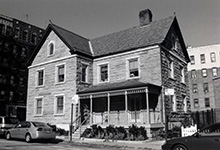

No one seemed to know Florence Bock very well.
But that doesn’t mean that no one cared about her.
Neighbors would bring her groceries. When the mail started piling up at her house on Perry Avenue in 2005, her mailman—whose route includes our offices — came to us and told us about it.
At least two other neighbors called the police.
So, the story here is not how a woman apparently died in her own home and lay there for two years without being noticed. Many did notice, were worried and took action.
The story is how, despite that concern and the involvement of several city agencies, that Ms. Bock could have been dead for two years in her own home without any of the authorities discovering her.
Ms. Bock’s pension checks were cut and mailed with regularity for two years after her presumed death and returned to the city by the Post Office. By several accounts, the police entered the home twice and came out having found nothing. The public administrator for Bronx County also sent an investigator to the house to no avail.
After our story in 2005, the Buildings Department sent out an inspector who saw nothing remarkable when everyone else in the neighborhood saw signs that something was wrong — a door ajar, broken windows, piled up mail. “No action necessary based upon physical observation,” was the report the inspector filed, according to the city’s on-line buildings database.
Maybe Ms. Bock’s body was hidden by the papers and other refuse that many have reported was in the home. But couldn’t some city official have taken responsibility for removing some of it to do a more thorough search?
The mailman and the residents of Perry Avenue continued to wonder about the situation, but having exhausted every option open to them, what else could they do?
If there is any silver lining to this tragedy, it is that people who barely knew Florence Bock cared about her just because she was their neighbor.
But the multiple representatives of the city whose duties intersected with the mystery of 3280 Perry Ave. need to figure out what went wrong and how they can do a better job if, God forbid, something like this ever happens again.
Irish Go, Spirit Stays
In the early 1990s there were 18 Irish bars on Bainbridge Avenue and East 204th Street. There was also an Irish gift shop and bakery and newsstands that sold county newspapers like the Anglo Celt and the Connacht Tribune alongside the Post and the Daily News. There still are a few Irish pubs in Norwood and Bedford Park, and a few Irish papers scattered around, but the area’s days as an Irish stomping ground are clearly behind us. The commercial landscape is now populated by businesses representing a panoply of ethnicities – there’s an Albanian bakery and specialty food store, several Mexican restaurants, a Mexican record store and a Bangladeshi grocery store. Local houses of worship reflect the influences of new groups – the packed Spanish Masses at local Catholic churches, a new Mass for Filipino parishioners of St. Ann’s, mosques well attended by Bangladeshis.
Meanwhile, Irish culture thrives just to our north in Woodlawn and, as Alex Kratz reports in this issue, people still flock back to some of the remaining pubs to reunite with old friends and family on St. Patrick’s Day.
The story of Norwood and the waves of Irish-Americans who once made it home is the story of many of the city’s neighborhoods. People come from far away in search of opportunity and a better life, and then, often, they go, for a variety of reasons.
But, like a layered sedimentary stone, all those who have stayed for a while leave their mark on a community’s identity. The never-ending story of Norwood, Bedford Park and the rest of the northwest Bronx continues to be written.

admin
Welcome to the Norwood News, a bi-weekly community newspaper that primarily serves the northwest Bronx communities of Norwood, Bedford Park, Fordham and University Heights. Through our Breaking Bronx blog, we focus on news and information for those neighborhoods, but aim to cover as much Bronx-related news as possible. Founded in 1988 by Mosholu Preservation Corporation, a not-for-profit affiliate of Montefiore Medical Center, the Norwood News began as a monthly and grew to a bi-weekly in 1994. In September 2003 the paper expanded to cover University Heights and now covers all the neighborhoods of Community District 7. The Norwood News exists to foster communication among citizens and organizations and to be a tool for neighborhood development efforts. The Norwood News runs the Bronx Youth Journalism Heard, a journalism training program for Bronx high school students. As you navigate this website, please let us know if you discover any glitches or if you have any suggestions. We’d love to hear from you. You can send e-mails to norwoodnews@norwoodnews.org or call us anytime (718) 324-4998.