



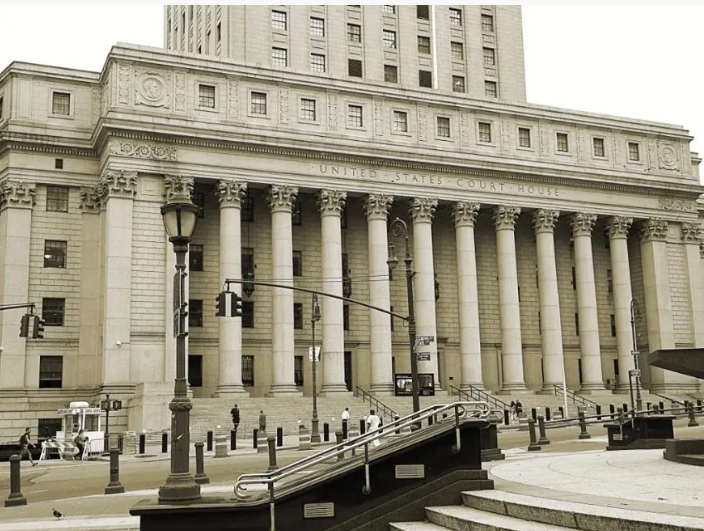
Photo courtesy of Rich Mitchell via Flickr
Federal prosecutors announced Friday, July 25, that Jonathan Banyan, 39, of Brooklyn, a convicted felon, was further convicted on Thursday, July 24, for entering a federal courthouse in lower Manhattan earlier this year while in possession of 18 rounds of ammunition.
The announcement comes amid increasingly frequent media reports of various disputes taking place with officials inside various Manhattan courthouses.
U.S. Attorney for the Southern District of New York Jay Clayton said that on April 7, Banyan brought ammunition into the Daniel Patrick Moynihan U.S. Courthouse located at 500 Pearl Street in Manhattan, and was later found guilty of the crime following a 4-day jury trial before U.S. District Judge Jed S. Rakoff.
“Everyone who enters a federal courthouse, judges and juries, lawyers and litigants, the press and the public, must know they are safe,” said Clayton following the announcement. “This conviction sends a clear message: ammunition carried by a convicted felon should not be tolerated in our community, let alone in the court.”
Norwood News has asked the press office for the U.S. Attorneys for the Southern District of New York for details of Banyan’s prior felony conviction and will share any feedback we receive.
Federal prosecutors said that on April 7, Banyan entered the courthouse wearing a backpack and inside it were 18 bullets in three different calibers. They said as Banyan passed through the security station, court security officers spotted the bullets. They said he grabbed the bag of bullets and tried to hide it in his pocket, but court security officers stopped him and recovered the ammunition.
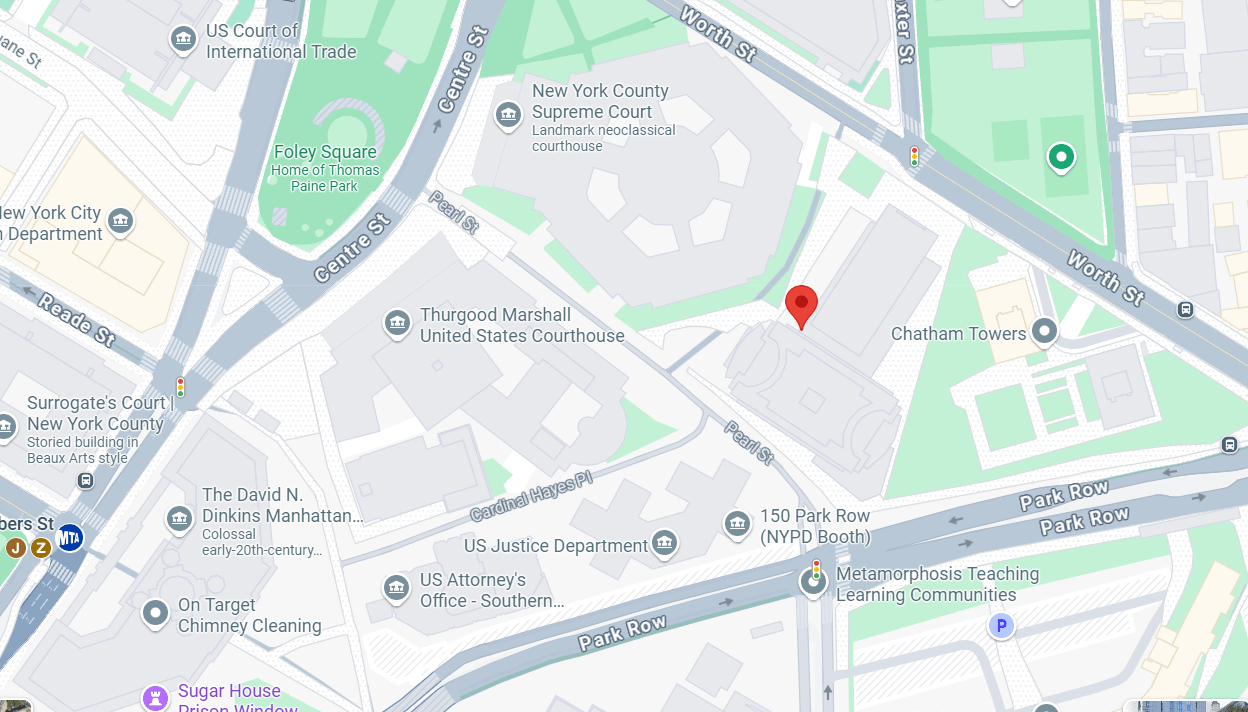
Image courtesy of Google Maps
They said Banyan was convicted of knowingly possessing ammunition after having been convicted previously of a separate felony, which carries a maximum penalty of 15 years in prison. They said he is scheduled to be sentenced on Dec. 1.
According to press guidance issued by the Office of U.S. Attorneys for the Southern District of New York, on Monday, April 7, the following trials were due to be heard inside the Daniel Patrick Moynihan U.S. Courthouse.
At 9.30 a.m., in courtroom 24A, the trial continued in United States of America ex rel. Uri Bassan, et al. v. Omnicare, Inc., et al., a civil False Claims Act case where the government alleged the defendants improperly billed federal health care programs for prescription drugs without a valid prescription, before Judge McMahon.
At 9.30 a.m., in courtroom 23A, the trial continued in U.S. v. Nadine Menendez, the defendant and wife of former U.S. Sen. Robert Menendez, who was charged with bribery, honest services fraud, obstruction of justice, extortion under color of official right, and foreign agent offenses in connection with a years-long bribery scheme before Judge Stein.
At 2 p.m., in courtroom 20A, a restitution hearing before Judge Moses was being held in U.S. v. Bill Hwang, the defendant, who was the founder and head of a private investment firm known as Archegos, and who was sentenced to 18 years in prison concurrently on each count charged for leading a criminal enterprise that manipulated the prices of multiple stocks and defrauded at least nine investment banks.
At nearby 40 Foley Square, in courtroom 518, at 11 a.m., a pretrial conference was being held in U.S. v. Andrew Franzone, the defendant, who is the founder and former general partner of FF Fund I L.P. Franzone was charged before Judge Broderick with securities and wire fraud for his role in a scheme to fraudulently induce more than 100 investors to invest approximately $40 million in his fund.
Norwood News also asked the federal prosecutors’ press office at what time Banyan entered the courthouse and if it’s known which court proceedings, if any, were potentially being targeted by Banyan. We will share any feedback we receive.
Though not quite the same situation, the fact that one of the listed legal proceedings on the day related to a health claim dispute is reminiscent of the cold-blooded, fatal shooting of United Healthcare CEO Brian Thompson on a Manhattan Street in the early hours of Dec. 4, 2024, allegedly by Luigi Mangione.
Mangione has pleaded not guilty in that fatal shooting case, which is ongoing. Based on inscriptions on bullets found at the scene, which spelled “delay,” “deny,” and “depose,” words seemingly sometimes used in rejected healthcare insurance claims, and based on other recovered evidence, media reports have suggested Mangione may be some type of disgruntled vigilante, who may have been trying to send a message and/or make an example of Thompson due to United Healthcare’s denial of healthcare insurance claims by applicants across the country. Mangione is presumed innocent unless and until convicted in a court of law.
Separately, another Manhattan federal courthouse, located at 26 Federal Plaza, has been the venue of other high-profile incidents involving federal DHS / ICE agents and those, including Congressman Adriano Espaillat (NY-13), who seek to protect the rights and ensure the welfare of detained immigrants amid allegations of poor conditions at the courthouse.
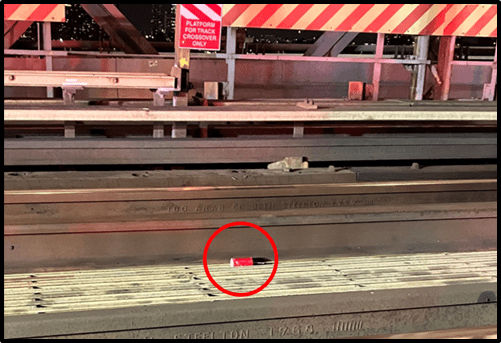
Photo courtesy of federal law enforcement
Clayton praised what he described as the outstanding investigative work of the U.S. Marshals Service, and also thanked the court security officers for their assistance. The prosecution is being handled by the General Crimes Unit for the Office of U.S. Attorneys for the Southern District of New York. Prosecutors said Assistant U.S. Attorneys James G. Mandilk, Ariana L. Bloom, and Nicholas S. Bradley lead the prosecution, with the assistance of Paralegal Specialist Samantha Roberts.
Meanwhile, federal prosecutors said a 55-year-old man from Inwood in Northern Manhattan, Michael Gann, was separately charged in federal court July 22 with making and attempting to use improvised explosive devices (IEDs) in Manhattan.
The court heard that in or about May, Gann ordered around two pounds of potassium perchlorate and around one pound of aluminum powder (precursor chemicals) online, along with over 200 cardboard tubes and over 50-feet worth of fuses.
Prosecutors said that in or about early June, Gann received his packages containing the precursor chemicals and other supplies, mixed the precursor chemicals together, applied a flame to the mixture, and caused an explosion. They said he subsequently assembled at least seven IEDs using the precursor chemicals, cardboard tubes, and fuses.
They said Gann stored the precursor chemicals and at least five IEDs on the rooftops of residential apartment buildings in SoHo. The pictured black device contained approximately 30 grams of explosive powder, around 600 times the legal limit for consumer fireworks.
They said Gann also stored at least four shotgun shells on the same rooftops, which he intended to combine with one or more of the IEDs and threw a sixth IED onto the subway tracks on the Williamsburg Bridge.
Federal prosecutors said on or about June 5, law enforcement agents arrested Gann in SoHo, and recovered a seventh IED from Gann’s person. Following his arrest, they said Gann falsely told law enforcement, in substance and in part, that he had disposed of the precursor chemicals and the shotgun shells in a dumpster in Manhattan.
In or about May and June, they said Gann conducted internet searches related to explosives and firearms, including: “will i pass a background check,” “gun background check test,” “can i buy a gun in any state without ffl [federal firearms license],” “3D gun printing,” “gun stores,” “clorine bomb,” “how to make flash powder from household items,” “what to mix with potassium perchlorate to make flash powder,” “alluminum powder,” “black powder nearby,” “quarter stick m1000 firecracker,” “1/2 stick dynamite,” and “rechargeable nail gun to shoot into steal.”
On or about June 5, prosecutors said just hours before Gann was arrested with an IED on his person, he posted to Instagram, “Who wants me to go out to play like no tomorrow?”
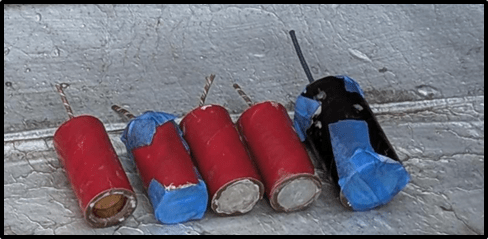
Photo courtesy of the federal law enforcement
They said Gann is charged with one count of attempted destruction of property by means of explosives, which carries a mandatory minimum of five years in prison and a maximum sentence of 20 years in prison; one count of transportation of explosive materials, which carries a maximum sentence of 10 years in prison; and one count of unlawful possession of destructive devices, which also carries a maximum sentence of 10 years in prison.
The minimum and maximum potential sentences are prescribed by Congress and provided for informational purposes only, as any sentencing of the defendant will be determined by a judge.
“This defendant allegedly stockpiled homemade explosives and traveled to New York City with these deadly devices,” said NYPD Commissioner Jessica S. Tisch. “He threw one of these devices onto an active subway track and stored others on the rooftop of a residential building, but because of the skilled investigative work and swift response from the NYPD and our partners, we were able to intervene before he caused any harm. I am grateful to the members of the NYPD, FBI, and the U.S. Attorney’s Office for all the work they do every day to keep New Yorkers safe.”
Gann is deemed innocent unless or until convicted in a court of law.

admin
Welcome to the Norwood News, a bi-weekly community newspaper that primarily serves the northwest Bronx communities of Norwood, Bedford Park, Fordham and University Heights. Through our Breaking Bronx blog, we focus on news and information for those neighborhoods, but aim to cover as much Bronx-related news as possible. Founded in 1988 by Mosholu Preservation Corporation, a not-for-profit affiliate of Montefiore Medical Center, the Norwood News began as a monthly and grew to a bi-weekly in 1994. In September 2003 the paper expanded to cover University Heights and now covers all the neighborhoods of Community District 7. The Norwood News exists to foster communication among citizens and organizations and to be a tool for neighborhood development efforts. The Norwood News runs the Bronx Youth Journalism Heard, a journalism training program for Bronx high school students. As you navigate this website, please let us know if you discover any glitches or if you have any suggestions. We’d love to hear from you. You can send e-mails to norwoodnews@norwoodnews.org or call us anytime (718) 324-4998.