


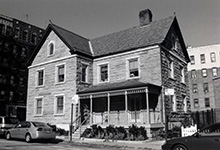

Our Lady of Refuge Church, on 196th Street, is under siege. Nearly every night, after longtime maintenance worker Luis Lugo closes the church compound’s 15-foot-high, chain-link gates, neighborhood kids climb over them, looking to cause a ruckus.
Lugo is usually able to chase them out, but he says it’s an example of how brazen, disrespectful and unwieldy the local youth have grown.
For decades, Our Lady of Refuge has acted as an oasis in the middle of one of the most crime-ridden neighborhoods in the northwest Bronx. Despite pleas by church leaders and local residents, drug dealing, youth violence, late-night muggings and illegal parties remain a constant thorn in the side of the community.
“It’s worse [now],” said Lugo, after testifying in front of a Community Board 7 public safety hearing held at the besieged church last Tuesday night. “The youth are domaining [sic] here and the police department doesn’t have the power to stop it.”
Board 7 leaders called the public safety hearing in response to an avalanche of complaints from residents throughout the board’s geography about everything from excessive noise, increased graffiti and prostitution to ubiquitous dog poop. Complaints like these are common, but the amount of them and the fact they came from all over the Community District 7 led Board members to believe, like Lugo, that the situation had become worse.
About 35 people, including board members, elected officials and city representatives attended the meeting. Deputy Borough President Aurelia Greene, Assemblyman Nelson Castro and Sigfredo Gonzalez, a staffer for State Senator Pedro Espada, Jr. all came for the first part of the hearing. Castro and Gonzalez both testified. Only about 10 non-affiliated residents came to the meeting and only a handful, including Lugo and Our Lady of Refuge pastor, Monsignor John Jenik, spoke. Their testimony was limited, but alarming.
One woman, who had just moved into an apartment on 197th Street in July, said simply, “This a terrible place to live.”
The recent transplant, who wanted to remain anonymous for fear of retribution, said an abandoned garage across the street from her home had been turned into a makeshift night club where people partied loudly until the early morning. The situation had deteriorated to the point that when the woman heard a neighbor threaten to kill the operators of the illegal club, she actually thought it wasn’t such a bad idea.
Another woman, a native New Yorker who said she moved to Norwood four years ago, said the neighborhood where she lives near the 205th Street D-train station had “turned into the Wild West.” She complained about blatant drug dealing and worried that the now unstaffed D-train station was turning into a haven for vagrants and criminals. The vacant parking lot on Webster Avenue and 205th Street, which is going to be turned into a new elementary school, had become a “garbage dump,” she said.
Castro talked about a block on 183rd Street and University Avenue that had become overrun with drug dealers.
Many said they were feeling a lack of police presence, which the Norwood woman thought was odd given that the headquarters of the 52nd Precinct (which is contiguous with Board 7) is just a few blocks away on Webster Avenue and Mosholu Parkway.
Lugo said the lack of police presence is allowing young criminals to believe there won’t be any consequences to their ill behavior. Right in front of the church, he said, teenagers play football with little regard for parked cars or passing pedestrians. Many of them, Lugo said, also deal drugs for some of the local operators. At night, underage drinking is rampant and completely out in the open. Teenagers have no qualms about tossing bottles at passing cars, Lugo said.
Lugo also runs a youth program for kids at the church and says he loses many of them to the streets. He said many of these kids see drug dealers wearing gold chains, riding around in Cadillacs and see role models.
“It’s hard for us to help our kids,” Lugo said. “They see [all the drug dealing] going on all the time and they think it’s not even illegal.”
Lugo said he’s worried it will eventually drive the good, working-class people out of the neighborhood, further driving it downhill.
According to police numbers, violent crime is down significantly in the 52nd Police Precinct. But the precinct is stretched thin in terms of manpower (the precinct is down nearly 90 officers from a year ago), meaning so-called “quality of life” calls, such as noise complaints, underage drinking and graffiti, have become a lower priority for patrolling officers.
After the meeting, Captain Phil Rivera, the precinct’s executive officer, said despite the lack of manpower, the precinct would find a way to beef up its presence. He said in addition to redeploying the precinct’s own resource, they would work with other agencies and other borough-wide police units, such as narcotics and transit, to complement them.
“We’re taking this very seriously,” Rivera said.
Board 7 Chairman Greg Faulkner said he thought it was good for the precinct to see that it wasn’t just the Board complaining about quality of life issues. “We want to work with them and start up a dialogue,” he said.

admin
Welcome to the Norwood News, a bi-weekly community newspaper that primarily serves the northwest Bronx communities of Norwood, Bedford Park, Fordham and University Heights. Through our Breaking Bronx blog, we focus on news and information for those neighborhoods, but aim to cover as much Bronx-related news as possible. Founded in 1988 by Mosholu Preservation Corporation, a not-for-profit affiliate of Montefiore Medical Center, the Norwood News began as a monthly and grew to a bi-weekly in 1994. In September 2003 the paper expanded to cover University Heights and now covers all the neighborhoods of Community District 7. The Norwood News exists to foster communication among citizens and organizations and to be a tool for neighborhood development efforts. The Norwood News runs the Bronx Youth Journalism Heard, a journalism training program for Bronx high school students. As you navigate this website, please let us know if you discover any glitches or if you have any suggestions. We’d love to hear from you. You can send e-mails to norwoodnews@norwoodnews.org or call us anytime (718) 324-4998.