



Rozen Dais waits for her 5-year-old daughter, Mya, after school at PS 85 and spends some quality time with her as they stroll to the library on Kingsbridge Road and then back to their Fordham apartment.
On most days, they stop to eat lunch at a well-respected Bedford Park establishment to enjoy a healthy, home-cooked meal, and sit together at a table with brightly colored linens and delicate flower arrangements.
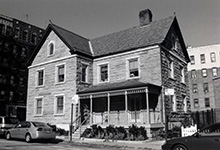
But Dais and Mya don’t go to a restaurant. They eat at the community dining room, or “soup kitchen,” at Part of the Solution (POTS), a nonprofit organization on Webster Avenue that has worked to assist families living in poverty for over 25 years.
This year, POTS plans to expand their services with a $6 million capital campaign to accommodate the growing need for its programs. In its new 15,000-square-foot building, POTS is especially hoping to assist a growing set of clients like Dais, who have permanent housing and either work or live on fixed incomes (such as food stamps or Social Security), yet still access the soup kitchen and food pantry to help stretch their incomes.
“[POTS] has been great,” said Dais. “I like the services. [The soup kitchen has] cooked food. Some places just have canned food.”
Up until a few months ago, Dais worked as a nurse’s aide and attended computer classes during the day, but quit both when she began having back problems. But even when she worked, she still came to the POTS soup kitchen, which serves around 300 meals daily.
According to Joel Berg, executive director of the New York City Hunger Coalition, the idea that only the homeless access emergency food programs, “is the greatest misconception about hunger in New York City,” he said. “That perception marginalizes people that are hungry.”
Berg estimates that 90 percent of people who access emergency food programs are not homeless.
Sister Mary Alice Hannan, POTS’s executive director, says that many working people can’t afford the high cost of food in addition to housing.
“The money they save by eating in the kitchen is money they can put toward their light bill,” Hannan says.
POTS offers several basic services, such as free haircuts, a shower facility, and a mailroom. But the soup kitchen and the food pantry are its most popular offerings.
In 2008, the food pantry and soup kitchen served a total of 300,000 meals, an increase from the 200,000 meals POTS served in 2005, said Maureen Sheehan, POTS’s development director. (The food pantry gives out its food by the meal, but clients must prepare them at home.) In the first quarter of 2009, the number of meals has already increased by 14 percent, Sheehan said.
Though the number of POTS clients has increased in the last year, Sheehan said the downward spiraling economy began affecting Bronx residents years ago.
“The fact is that our community has been hurting for three years,” said Sheehan. With food and housing costs on the rise, she said,
“It’s not surprising that you put those together and the need for POTS services goes up 50 percent [since 2005].”
Other local social service groups are also seeing a shifting increase in their clientele.
Sally Dunford, executive director at West Bronx Housing, a nonprofit that helps people with a wide range of housing and other issues, has also seen the number of clients double in the last two years. More clients are asking for assistance with bills and filling out paperwork for food stamps. “Ten years ago it would have been a senior [coming for services],” she said. “But more and more we see working families, more folks with children.”
At Concourse House in North Fordham, Executive Director Manuela Schaudt has seen a similar trend in the women who come to the transitional housing program, where 40 percent of women work.
Five years ago, women often came to Concourse House battling substance abuse or to escape domestic violence, Schaudt said. Now, a typical client has just lost her job and can’t afford to pay rent. “There is no stereotype anymore,” she said.
In the new POTS building, just next door to the original building on Webster Avenue, where construction will begin in October, the organization will expand its legal center and anti-hunger advocacy program. The soup kitchen will seat up to 55 people at a time (twice the current amount), and they will have a larger food pantry where clients can select their own groceries.
The new pantry will help Saira Bryan, 58, who comes to the POTS food pantry with her 4-year-old grandson. Bryan pays $850 in rent, but only makes $1,000 a month babysitting children. She accesses the food pantry because the “food is good” and “it’s stuff I don’t have to buy,” she said.
Angela Duran, 53, who receives $232 in food stamps for her husband and 17-year-old daughter, also comes to the POTS pantry. Duran travels to a large warehouse supermarket in Washington Heights because “I can buy more there,” she said. But she still goes to POTS to help with more expensive items, like milk.
Berg says the poor who were surviving without assistance and individuals at the edge of lower-middle class will now have to access emergency food services for the first time, leaving many programs overtaxed. “A lot of smaller programs and smaller food pantries are running out of food,” he said.
With summer around the corner, and kids going on vacation, Sheehan and Hannan said that the number of families coming to the soup kitchen will only increase.
“We will be inundated with people who need help,” said Hannan. “Our [regular clients] will understand, but it’s the new poor that we hope won’t be lifers,” she said.
Dais hopes she’s not one of the lifers but, “I am worried,” she said. “I hope it gets better. I would like a job in the future.”

admin
Welcome to the Norwood News, a bi-weekly community newspaper that primarily serves the northwest Bronx communities of Norwood, Bedford Park, Fordham and University Heights. Through our Breaking Bronx blog, we focus on news and information for those neighborhoods, but aim to cover as much Bronx-related news as possible. Founded in 1988 by Mosholu Preservation Corporation, a not-for-profit affiliate of Montefiore Medical Center, the Norwood News began as a monthly and grew to a bi-weekly in 1994. In September 2003 the paper expanded to cover University Heights and now covers all the neighborhoods of Community District 7. The Norwood News exists to foster communication among citizens and organizations and to be a tool for neighborhood development efforts. The Norwood News runs the Bronx Youth Journalism Heard, a journalism training program for Bronx high school students. As you navigate this website, please let us know if you discover any glitches or if you have any suggestions. We’d love to hear from you. You can send e-mails to norwoodnews@norwoodnews.org or call us anytime (718) 324-4998.